
Arsenal’s complete lambasting at the hands of (arguably) the best attacking club in the world underscored a lot of opinions this weekend. Funny thing is, those opinions fall on all ends of the spectrum.
Perhaps you believe Mikel Arteta is taking the club nowhere. To go to Anfield and lose by four, then, is only proof that Arsenal haven’t improved. After all, any club chasing a European place should be able to compete.
If you feel like you’ve noticed improvement this season, you may feel like you saw encouraging signs at Anfield before half-time. The collapse was humiliating, sure, but this is a young club, they’ve rattled off some wins, and a bounceback against Newcastle is on the cards. It would have been unreasonable to expect this group to shock one of the best all-around teams in Europe, after all, and at least two of the goals were about coachable blunders, not overall poor team performance.
No matter which side you’re on, you’ve probably heard talk about Arsenal’s expected goals (xG), expected goals allowed (xGA) and expected goal differential (xGD).
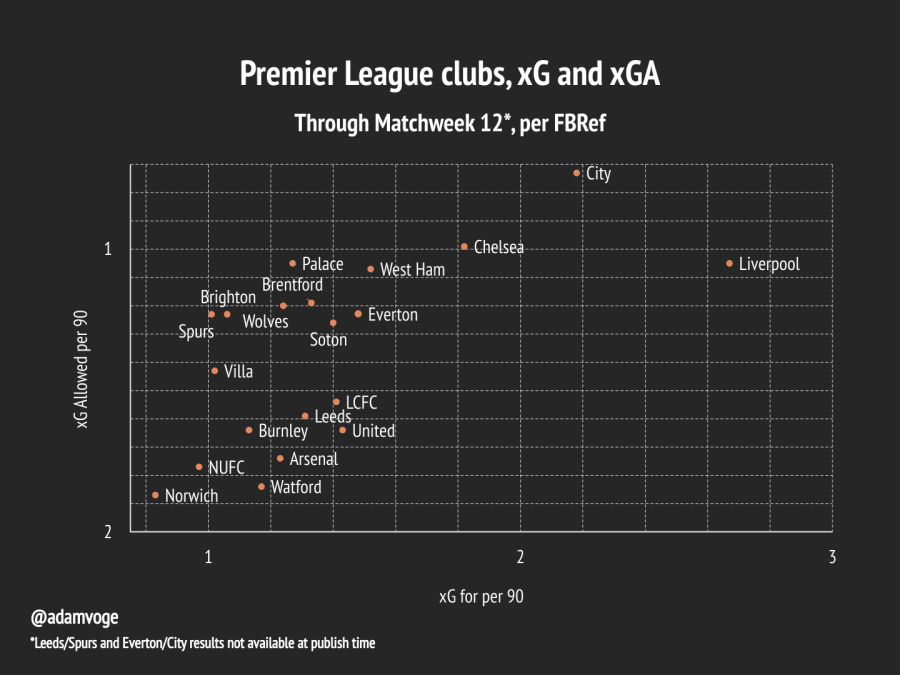
In short: It’s not good. After the fiasco at Anfield, Arsenal now sport a -0.51 expected goal differential per 90 minutes, essentially indicating that the “average” game consists of Arsenal’s opponents creating a half-goal’s more chances than the Gunners. That differential is 16th in the Premier League, and 76th among the 98 clubs in Europe’s five biggest leagues. Arsenal are 12th in expected goals, and 17th in xG allowed. Here’s what it looks like plotted on a chart:
That’s terrible, right? Last season, Mikel’s tricky reds finished +0.24 per 90 minutes, sixth in the league and 28th in the big five.
This fact has been touted like a weapon by some against both Arsenal as a club, and Mikel Arteta in particular. So what should we make of this? Are Arsenal really on part with the likes of Watford, Burnley and Newcastle? Or is there more to it? I’m not the leading authority on xG, but here’s some context to consider.
First off: what has happened to Arsenal against Manchester City, Liverpool and Chelsea was not good. Nor was it acceptable. So please don’t twist this into a column trying to justify those performances. After all, if this club is going to reach the Champions League again, part of that territory must include being more competitive against the Big Six.
What I am here to argue is this: xG totals, and even means, for this season have been rendered more or less meaningless, at least for the time being. That is, unless you believe Arsenal’s average result should be a draw or one-goal loss. Maybe you do think that. If so, it’s probably time to stop reading.
Now, consider this: Arsenal’s total xG differential this season is -6.1, per FBRef. That’s tied for 16th, with Burnley. Burnley!
But how did we get there? -2.6 of it is from Chelsea. Another -3.7 from City. And then, the glorious -3.9 from Liverpool. That’s -10.2 from three games. U-G-L-Y.
That also means Arsenal are +4.1 in the other nine games, which includes a -0.3 showing against Leicester (won 2-0) and a -0.2 showing against Spurs (won 3-1). That goal differential is pushing for fourth in the league, with West Ham right there at +0.45 per 90 minutes.
Those three ugly losses, regardless of the circumstances that created them, were terrible. In fact, Liverpool’s showing was the best by xG in the Premier League this season (FBRef). City’s was fifth-best.
I repeat: I’m not here to argue that they were acceptable. But perhaps in the context of an xG study, it’s wiser to look at what Arsenal have done without them.
Consider this: Arsenal’s xGA is made up 52.6% by expected goals created by Chelsea, Liverpool and Manchester City. They’re the only club in the league with 50% or more of their xGA allowed in just three games, next being Southampton, who allowed 49.7% of their xG against Chelsea, Everton and Manchester United (7.5 xG out of 15.1 total).
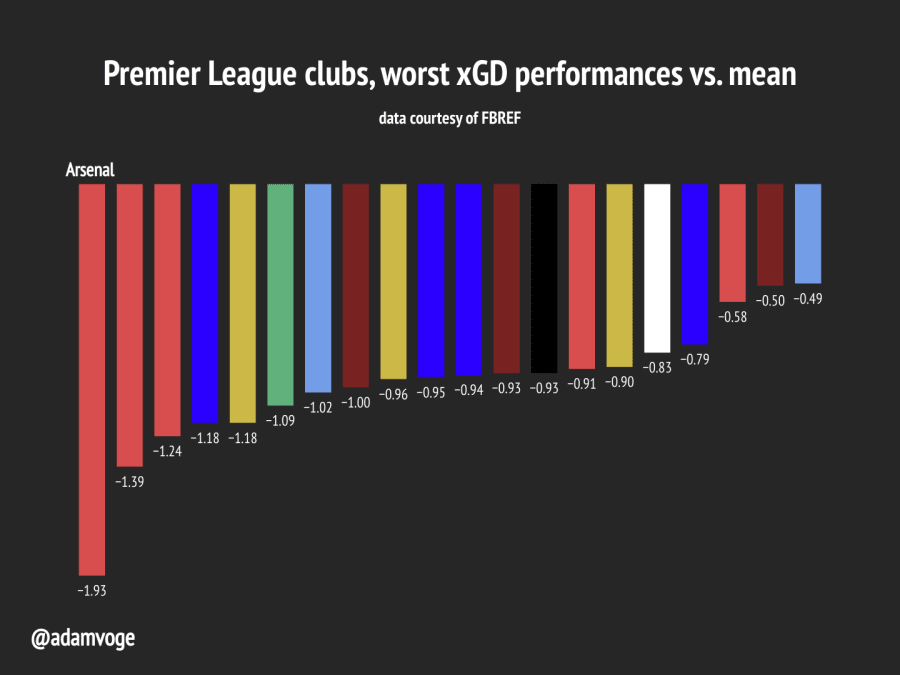
So that’s by percentage. By sheer volume, Arsenal’s three worst performances have totaled 11.0 xGA. That’s the most xGA allowed in a club’s worst three games in the league, worsting Manchester United’s 9.1 (Liverpool, Leicester, Watford).
The mean of those three performances is also nearly two goals worse per 90 minutes than their overall mean for the season, including the big losses. That number essentially suggests that Arsenal’s worst losses have been particularly bad compared to a “typical” game so far this season (chart above).
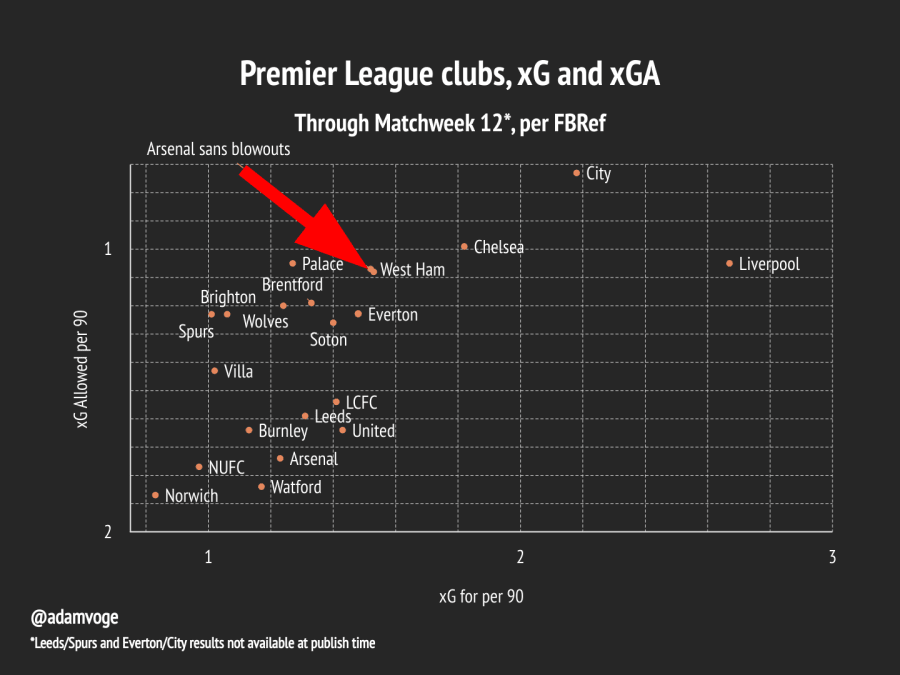
Here’s what happens when you add a data point for Arsenal that doesn’t include those huge losses. To no one’s surprise, it’s neither league-leading, nor bottom-table. It’s certainly more in keeping with European football as a goal, rather than eighth place.
Another thing to keep in mind: This chart does include the wins over Leicester and Tottenham, both of which I’d argue were essentially in Arsenal’s control by half-time, but ended in losses by xG thanks to the imbalanced second halves. Was either performance a disappointment to you? If so, comment below, because I’d like to hear why.
One thing I will say about xG in general: Arsenal’s xG for is lower than I’d like. So far we’ve seen only two performances where the Gunners amassed at least 2 xG, something they did 9 times last season. Lower the bar to 1.5 xG, around a sixth- or seventh-place value this season so far, and Arsenal have gotten there four times this season, compared to 15 a season ago. Maybe different circumstances against Leicester and Tottenham would’ve resulted in 1.5, but we’ll never know.
Here’s the thing about this xG debate: I don’t think anyone is about to change their debate opponent’s mind. If you’re set on proving the club isn’t good enough, then regression is coming. If you’re an optimist, then the 9 games they didn’t get blown out in are the trend, not the three big losses.
While this club is still young, we can afford to have debates like this. By some point down the road, perhaps even next year, losses of such an imbalanced nature will be unacceptable, no matter who’s in charge. Personnel and inexperience simply won’t be excuses any longer.
If you’re reading this and wondering how to feel, here’s a little mental experiment for you: Would you rather be higher on the table than where your xG says you should be? Or would you rather be last season’s Brighton, a top club by xG but lower-middle on the table? Something to think about.
I don’t really know how this season is going to play out. But no matter which direction it does, I’ll tell you this: Being in fifth place right now is fun, and we as fans should enjoy it, and hope we can go even higher.