Geoff Shreeves, the post match interviewer for Sky Sports, is undergoing a renaissance as a “proper” inquisitor these days. Gone are the inane post match queries (“are you happy you won?”/”sad you lost?”), for now at least, and recently arrived have been two decent interviews; first with Edu and, recently, Josh Kroenke. Josh, channeling his best “Jack Dorsey” impression, gave what I thought was a quite open and (almost) honest account of himself – albeit you could see he has had plenty of media training. He was polished and prepared (and groomed), as you would expect, but one comment, made on the subject of Daniel Ek’s recent bid for the club, raised eyebrows;
“The club is not for sale, we’re just getting started. We’ve only really owned the club since 2018. We have a young manager, we have a young squad and we’re charting our path to the future.”
Hmm. Not sure about this. The first and last bit I can understand. But the comment on he and his dad’s “real” ownership of the club is quite interesting. Of course, we all know this is bullsh*t don’t we? Silent Stan first acquired a stake in Arsenal Holdings Limited (the parent company of Arsenal FC) in 2007 and incrementally increased his stake up until 2018 where he did, finally, assume full ownership (but had full control at an earlier time…). For some of this period, the Kroenke’s were minority shareholders, for the rest they weren’t. They were certainly majority shareholders (thus decision makers) long before 2018.
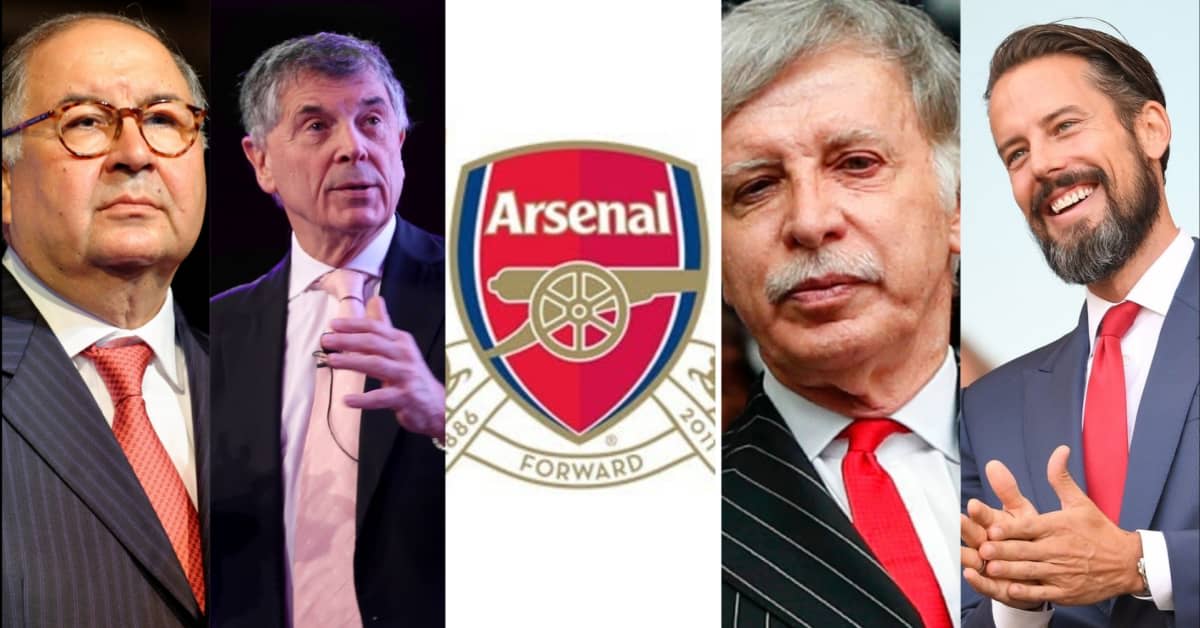
But how did this happen and why is what Josh said not strictly true? To understand this, we need to revisit The Battle of the Boardroom. The “New Cold War” between Russia and the USA. Rocky vs Drago. The ultimate match up in the exciting and bloodthirsty world of corporate finance and company governance: Usmanov vs Kroenke.
I was trying to be funny there by the way. A lot of this can be quite boring, writing about two little rich boys fighting over a nice toy. However, if you bear with me, it is quite revealing…
Stan Kroenke was introduced to Arsenal by David Dien, who believed that the club “needed a Billionaire” to help propel the club forward (demonstrating the accurate foresight which was one of a few key components of Dein/Wengers’ earlier success). Kroenke, with Dein’s encouragement, acquired ITV’s 9.9% stake in the club in 2007. This promptly outraged the board of directors (Peter Hill-Wood, Danny Fiszman, Nina Bracewell-Smith, Chips Keswick, Ken Friar, Lord Harris of Peckham, Richard Carr and Keith Edelman) who turned on Dein for allowing an “outsider” to acquire a stake in the club before consulting them first.
The irony being that the same board of directors would go on to embrace Kroenke and pave the way to his eventual full ownership.
Dein, angered at being frozen out, promptly sold his 14.5% stake to Alisher Usmanov (via his vehicle: Red & White Holdings Limited). Usmanov continued to acquire smaller shareholdings, building up to an eventual stake of 29.25%. Meanwhile, Kroenke (or more accurately, KSE UK Inc) also hoovered up minority shares (as well as a fairly large sum from Danny Fiszman – who had originally bought his from Dein) and reached 29.9% by November 2009. The remaining director/shareholders then agreed first options on each others shares while Kroenke agreed a hiatus on making any further offers. This effectively boxed Usmanov off, preventing him from launching any kind of takeover, hostile or otherwise.
During this period of upheaval, Usmanov was never made a director. His shares carried voting rights, but without a seat at the table and facing a steadily unifying cohort of director/shareholders – he was rendered impotent. Kroenke, on the other hand, was made a non-executive director then director by September 2008. Dein, so much the key powerbroker and architect of much of the clubs success, was as welcome as a Tottenham supporter mooning in the Marble Halls.
Both Usmanov and Kroenke were engaged in a battle to tip their respective stakes over the 30% mark, as, including the remaining shareholders, any level above this would make them majority owners and compell them to invest heavily to acquire the remaining shares from the other investors. Crucially however, at this low level, they could still be out-voted by the remaining shareholders (if they banded together and used their combined majority) as the structure of the shares gave only a single vote per share.
With Usmanov neutered, Kroenke became the majority owner, with full control, by April 2011, by acquiring Bracewell-Smith and Fiszman’s remaining shares, increasing his stake to 66.64%. The company audited accounts for the period confirmed the same, with KSE UK Inc now the owners and controllers of Arsenal. Kroenke was then compelled to make an offer for Usmanov and the remaining shareholder’s respective stakes (under rules which oversee company takeovers) – eventuality taking the club into full, private ownership in August 2018.
What was even more ironic (more so than Dein introducing Kroenke to Arsenal and then being frozen out) was that Dein was said to be largely against The Emirates Stadium move while Fiszman saw it as a means of the club continuing its self-sustaining financial model – i.e. not relying on a Billionaire to bankroll the club. Billionaire Stan Kroenke bought into this, content with the notion the club could become another, passive income stream to KSE (more on this later).
So, Josh stating that KSE UK Inc “only really owned the club since 2018” is an exaggeration. Let’s say he was economical with the truth.
But what could he mean by this statement he knows isn’t entirely accurate? By taking the club into full, private ownership, the Kroenke’s get the full benefit of the clubs overall value as an investment and also its income streams (i.e. no other investors, such as fans or institutional investors, to share the wealth with or convince to vote for your plans/strategy). Other benefits of private ownership are that the Kroenke’s aren’t mandated to follow US Securities Exchange Commission or London Stock Exchange regulations and rules concerning reporting aspects of the clubs financial performance (as a publicly listed company – as it was prior to 2018), no requirement for public Annual General Meetings (to be held accountable by fans/fan groups as they used to) and enjoy a greater deal of anonymity around disclosing and reporting financial reports – amongst quite a few more.
Regarding the latter – this actually works in the clubs favour as rival clubs, agents and pundits will find it more difficult/have to work harder at finding out how wealthy the club actually is, as the Kroenke’s can keep how they move money around and what actually is available for transfers between KSE and Arsenal Holdings Limited somewhat secretive. Arsenal remain a big club, so we will always pay more for players than “smaller clubs” given our perceived size and wealth – its just a bit harder to accurately quantify in private ownership.
Another reason is purely self interest. Imagine majority owning a house with minority owner you hate. You, as majority owner, are compelled to use your wealth to grow your investment – but at the same time you grow the others’ investment too. You put in the funds and take the risk – the other doesn’t. The Kroenke’s likely viewed Usmanov the same – why invest serious money in the club or team before assuming full, 100% ownership, as any return on the investment would be shared with Usmanov – who in this example contributes nothing. Now, to be fair, I do think the Kroenkes did invest in the club before 2018, however it was done behind closed doors – as is normal for a privately owned company. One under valued aspect of their ownership is providing a financial safety net – using the pooled resources of KSE to support its investments. However, football supporters quantify an owners interest by the level of cash the club spends on transfers, there needs to be an element of business conducted in public, which I’m not sure the Kroenkes really understood.
Why is any of this important? Well, firstly it shows the previous regime were only too happy for Kroenke to take control of the club. Second, the previous regime were as “tight” with the purse strings as the Kroenke’s are accused of being. The Kroenke’s clearly took the idea of being “self-sustaining” totally literally.
With the benefit of hindsight, one valid criticism that is safe to say is that the Kroenke’s massively misunderstood/did not fully appreciate what it meant to own a football club in the Premier League. As stated above, Kroenke liked the idea of Arsenal being self-sustaining. An investment he could watch from afar with minimal involvement. For me, this partly explains the arms-length, “Silent Stan” moniker that Stan has earned, the lack of communication up until the last few years.
KSE has many sporting franchises (I hate that word) and I don’t believe for a minute that the others in the US get the same level of attention and focus as Arsenal (now) get. My assumption, and it is purely that, is that the Kroenke’s believed they were buying into and took ownership of a successful, self-sustaining, self-managing club that required little intervention from the owner, if any. That Arsenal could simply continue ticking along, continuing being (moderately) successful, generate satisfactory profit levels and steadily grow in value.
Whether I am right in my assumption or not, it’s good Josh has assumed control at Arsenal, that he has stepped up. If we could, rightly, criticise the Kroenke’s for appearing to be ignorantly hands-off, we cannot now criticise Josh for taking a more active and public role in the management of the club. I have no knowledge of how KSE’s US-based franchises are managed, but I think it’s also safe to say the Kroenke’s didn’t know the full extent of what they had at Arsenal (for better and for worse) until they became 100% owners. Maybe Josh cites 2018 as the moment the penny dropped for the Kroenke’s – as I have outlined above.
While Josh et al come out with carefully worded statements (especially with the Amazon cameras around), it is possible to read into them and deduce the owners mindset. Whatever was the case, whether I’m right or wrong, the Kroenke’s finally have an opportunity to become the right custodians of Arsenal. Not frivolous spenders, not interfering egos. Not hands-off owners, leaving the club to drift without guidance or financial support. If Josh continues to balance his role and that of the management properly, the next 10 years of their “full ownership and control” of Arsenal has potential to be more successful than the last.
Now they “get it”- let’s hope we can continue to “get excited” about the clubs upward trajectory.
Ownership & Control: How (and when) the Kroenke’s achieved both.