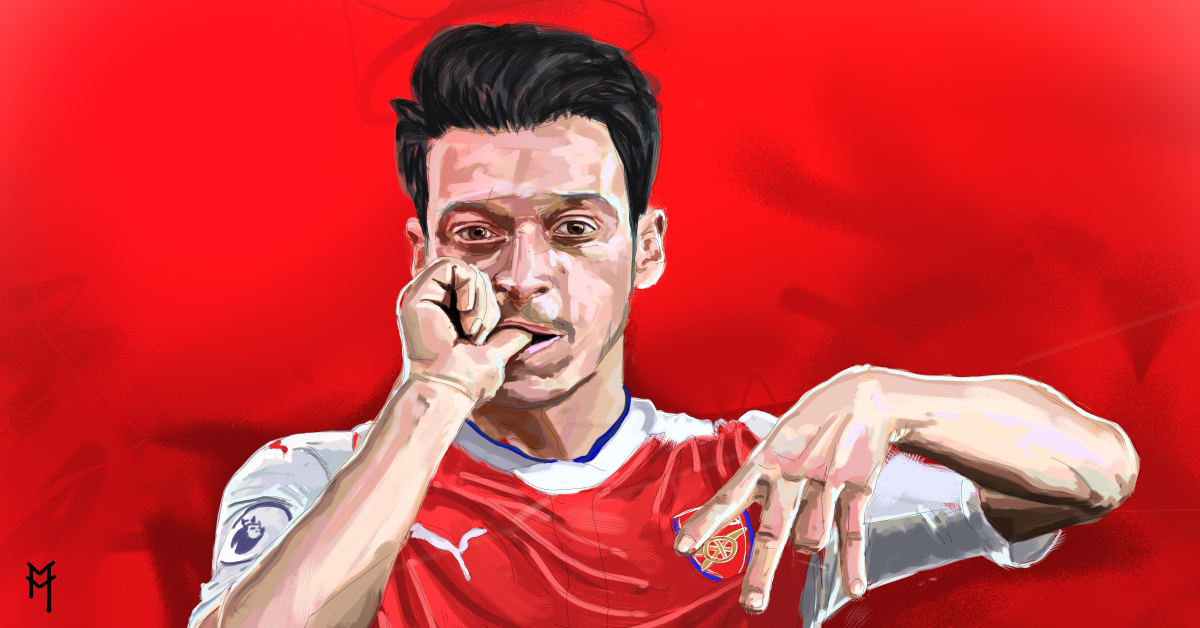
Yesterday, one of the greatest playmakers to ever grace the Premier League bid adieu to Arsenal football club. Mesut Özil, a name that divides the fanbase like no other, sealed a much-anticipated move to Fenerbahçe.
It’s reported that Arsenal and the German came to an agreement to mutually terminate the remainder of his contract. The 32-year-old signed a three-and-a-half-year deal with the Turkish giants, a club he supported as a young child.
To describe the German as polarising would be underselling it, but regardless of how you feel about him, this was undoubtedly the best time for him to move on. Here’s why.
End of the War
When Mikel Arteta made the ‘footballing decision’ to not register Mesut Özil for the first half of the 2020/21 season, the writing was on the wall. Since then, the animosity between player and club has only intensified with little jabs going back and forth. Many believe this all emanated from when the World Cup winner bravely stood up for the Uighur Muslims who are being persecuted in China. In response the club shamelessly distanced themselves from him in fear of backlash from the Asian nation.
From that moment, the two parties were never going to see eye to eye. Özil’s PR would, later on, take advantage of the club’s unfortunate furlough situation as he’d offer to pay the wages of Gunnersaurus after he was laid off by Arsenal. This prompted a defiant response from a club spokesman, further deepening the wound in this relationship.
The saga revolving around the club’s highest-paid player not playing can finally come to an end. Whenever Arsenal lose, there are cries for the 32-year-old to be included in the squad while when we win without him, his detractors gloat excessively. Either way, this circus has performed its last show.
Past his Prime
Despite his clear decline in physicality, the 32-year-old’s technical ability has never deteriorated. However, to play in a Mikel Arteta team, what you do off the ball is just as important as what you do on it. Özil’s body just won’t let him comply with such demands and the Spaniard wasn’t willing to carry any passengers. Look at Emile Smith-Rowe, he may not be as technically gifted, but his running stats are off the charts, allowing him to press the opponent as well as make third man runs into the box.
Last season, in only 18 appearances, the playmaker provided 2 assists, 1 goal and created 37 chances. However, it must be noted that a lot of these chances were from dead-ball situations. The fact of the matter is, Özil’s ability to influence games at the top level has diminished due to his declining physical traits.
Hale End FC are here
A new era has begun at Arsenal. Hale End FC aren’t just here to participate, they’re here to take over. The emergence of Emile Smith-Rowe has drastically changed the landscape in North London. He has shown the fans that there is indeed life after Mesut Özil. Of course, he’s not the finished article but he’s given Mikel Arteta’s team a much-needed productivity boost.
That’s not to say that the Gunners won’t sign a creative midfielder in this window or the next, but ESR’s emergence has given them a worthy successor to the German’s legacy. The 20-year-old is the perfect example of how the #10 role has evolved in modern football, it is no longer a free role where you’re solely judged on your final third actions, but also your pressing and tracking back. The youth have proved they can meet football’s modern-day demands, while Mesut Özil has not.
Just for the record, I feel Mesut Özil is one of the greatest playmakers to ever grace the game. His vision was unrivalled, his touches were unfathomable and his movement was sometimes captivating. However, for whatever reason, it has not worked out the way it should have and we must now gracefully move on from the Mesut Özil era.