Martin Odegaard is on the verge of signing for Arsenal on a permanent deal. Let’s take a 360-degree view of the player.
On 27th January 2021, Martin Ødegaard joined on loan from Real Madrid for the remainder of the season. He played 20 games for the Gunners, 14 in the premier league and 6 in the Europa League. An ankle injury prevented him from featuring in a further 4 games between 5th April 2021 and 20th April 2021.
With Ødegaard saying his goodbyes to Arsenal at the end of his loan spell, it was expected that he would go back to Madrid and play for the Spanish giants. However, football is seldom straight forward and with Ødegaard growing in discontent over his role at the club, various reliable Spanish outlets have reported that a transfer back to Arsenal is already advanced.
Arsenal endured one of their worst seasons in the top flight and finished eighth in the premier league for the second time in a row and ended the campaign without qualifying for Europe for the first time in over two decades.
However, the gunners did have an improved campaign after Christmas and accumulated the most points in the league after Manchester City. This was down to the emergence of Saka as a right-winger along with the creative impetus provided by Emile Smith Rowe and Ødegaard.
While Ødegaard shined in the north London derby and in the 3-3 draw away to West Ham, he was also conspicuously absent in other games, most notably the Europa semi-finals. In the process, the fan base is divided on whether to bring back the Norwegian attacking midfielder.
Despite the wealth of experience behind him and being the captain of Norway, Ødegaard is only 22. So let’s take a look if his rumored move to Arsenal would turn out to be a good acquisition for the Gunners.
THE BEGINNING:
Ødegaard was born on 17th December 1998 in Drammen, Norway. His father was a professional footballer who played in midfield and now coaches Sandefjord, a team in the top flight of Norwegian football. It was little surprise that Ødegaard started playing football from a very young age and initially played for Drammen strong and was coached by his father for a while.
At the age of 6, his parents chipped in to buy an artificial turf for him to play on seeing his talent. In 2009, Ødegaard joined the youth division of Strømsgodset in Norway.
He represented his district of Buskerud in a tournament, aged 11 conducted by the Norwegian Football Association and played head and shoulders above opponents 2-3 years older than him.
His coach at the time was quoted saying that “he has a nice touch and handles himself brilliantly”
At 12, he was already part of a nationwide U-16 tournament where he dazzled the country and Lars Tjærnås, a former football manager who said that “We are something out of the ordinary”
Aged just 13, he made his way into the Strømsgodset first team and already had visits to Bayern and Manchester United.
At the tender age of 15 years and 118 days, he became the youngest player ever in the history of Norway to play first division football, and at age 15 and 150 days, he became the youngest goalscorer in the history of Norwegian first division football.
For a more in-depth look into his formative years, would suggest that you have a watch of this extremely well-made documentary.
Norway had woken up to the news that they had a footballing prodigy. Claims were made for him to be promoted to the national team. Liverpool legend John Arne Riise was one among those strongly pushing for Martin to be part of the national setup. He was influential in this first season for Strømsgodset and the club finished fourth and qualified for the Europa League.
By that time, the world started to notice and he already had trials at Liverpool,Bayern, Real Madrid, and….Arsenal!
Arsene Wenger was a huge fan and wanted the Norwegian at the Emirates.
THE NEXT CHAPTER:
On the 21st of January 2015, it was Real Madrid who won the race for Ødegaard for an initial price of 3m euros which would reportedly rise to 8m-8.5m euros if certain clauses were met. Such was the hype that it was announced that Ødegaard would train with both the first and reserve team, Castilla which was managed by Zidane at the time.
It seemed at first that Madrid had landed a coup. Ødegaard took the number 21 shirt and was named in the Champions League squad. He made his debut for the reserve team (Castilla) and soon scored his first goal.
However, things then took a sharp turn. There were reports of difficulty in acclimating to a new country and also issues of a language barrier.
He was dropped from the Reserve team after a string of 3-4 losses and while the current first-team coach Ancelloti, urged the Madrid faithful to allow Ødegaard to adjust to a new country, he later revealed in a book that he was never consulted and that the signing was a “PR stunt”
Ødegaard made one appearance for Madrid on 23rd may 2015 as a substitute for Cristiano Ronaldo in a match which saw Real win 7-3 over Getafe. He spent the rest of his time featuring for Castilla again and had performances that drew praise from the local press.
EXILE?:
On the 10th of January 2017, Ødegaard made this his first of several loan moves when he agreed to an 18th month to Heerenveen, a team playing in the top division of Netherlands football.
In his first 15 appearances, he had one goal and one assist. At one point, he was described as a “luxury substitute” who played 4 mins in three games by the press back in Spain. The Norwegian press felt he would eventually be a good player but not someone who could play for Madrid. The Heerenveen hierarchy for their part also said that they did not know how to fit him into the team.
In due course of time, he did become a regular starter but the excitement around the player was dying. He returned to Madrid and was again sent on loan for the 2018-19 campaign to the Netherlands, this time joining Vitesse on loan.
Ødegaard made a total of 39 appearances and contributed 11 goals and 12 assists and Vitesse finished 5th in the league table and qualified for the Europa League playoffs. In his 39 appearances, 23 were from a right-wing position while he was deployed as a central attacking midfielder and right midfielder 7 times each as well.
He had solitary appearances as a striker and as a left midfielder during the course of the season. Ødegaard had one of the highest dribble completion rates of the season, clocking in at an impressive 74%. He did not attempt as many dribbles as other wide players but analysts noted that his intelligence allowed him to decide when to dribble and when not to.
What was most striking was his offensive and defensive inputs. He averaged 3.3 key passes per 90 minutes from open play and 1.4 key passes per 90 from Corners or free kicks. Odegaard played in a defensive 4-4-2 and was seen frequently pressing the opposite left-back and also did not mind the dirty work with plenty of tackles.
With Ødegaard finally starting to find his feet, he returned to Madrid and went on loan again to Real Sociedad. It was one year loan with an option to extend for a further year. At Sociedad, he played in a 4-3-3 where he would be a right attacking midfielder who could exploit the space both in central areas as well as on the flank
He outperformed the league standard in assists, through balls, passes into penalty areas, progressive passing, and shot-creating actions. However, he was average in the goal-scoring department. In September 2019, he won the La Liga player of the year award and was hailed by many including the press as the successor for Luka Modric.
At Sociedad, the coach employed a midfield that allowed a staggered #6, #8, and #10 role.
In this setup, Martin was the #10 and formed a formidable partnership with Zubeldia (#6) and Mikel Merino (#8). His 63 through passes rank only behind Messi. He was defensively excellent earning 4.3 recoveries per game, 2.7 of which come in the opposition’s half.
Another factor that helped Ødegaard was the presence of a mobile striker like Isak rather than Willian Jose. Isak allowed Ødegaard to ping in through balls and also offered him space in central attacking and wide positions.
Ødegaard was now a fine midfielder but the only issue was his goal output. However, he was forced to play through pain after a heel injury in 2019 which resulted in him taking lesser shots and also reduced his mobility. He was also effective in dropping deep to create passing options when the opposition pressed.
In February 2020, he scored to knock Real Madrid from the Copa Del Ray quarter-finals. The cries to bring the Norwegian back to the Bernabeu became even louder. He returned to Madrid helping Sociedad to a 6th place finish and in reaching the finals of the Copa del Ray.
For the 20/21 season, he had started for Madrid in both the La Liga and Champions League. However, he was injured twice with calf and muscle injuries that forced him to miss prolonged periods of games.
BECOMING A GUNNER:
With Zidane having his preferred midfielders, Ødegaard headed to Arsenal on loan on 27th January 2021. His performances divided the fan base but a closer look suggested that he massively improved the Gunners’ team. Ødegaard operated as a traditional #10 in a 4-2-3-1 while having Emile Smith Rowe as a left-sided wide creator.
The following stats are from James Lloyd of Breaking the lines.
Ødegaard averaged 2.5 key passes per 90minutes in all competitions, the highest for any Arsenal player, and his expected assists were higher than of Smith Rowe. During this time, his numbers for key passes were bettered only by Mason Mount, Bruno Fernandes, and Kevin De Bruyne.
His progressive passing was bettered only by a few and were equal to Tielemans and Rodri.
Ødegaard averaged 20.7 pressures per 90, succeeding in 6.0 of them, and was in the 93rd percentile of Premier League attacking midfielders for successful pressures.
His goal output however was not something to write home about. In 20 games, he scored 2 goals and had 2 assists. However, his play extends beyond just goals and assists which was shown in the 3-3 draw away to West ham, where he was central to all three goals.
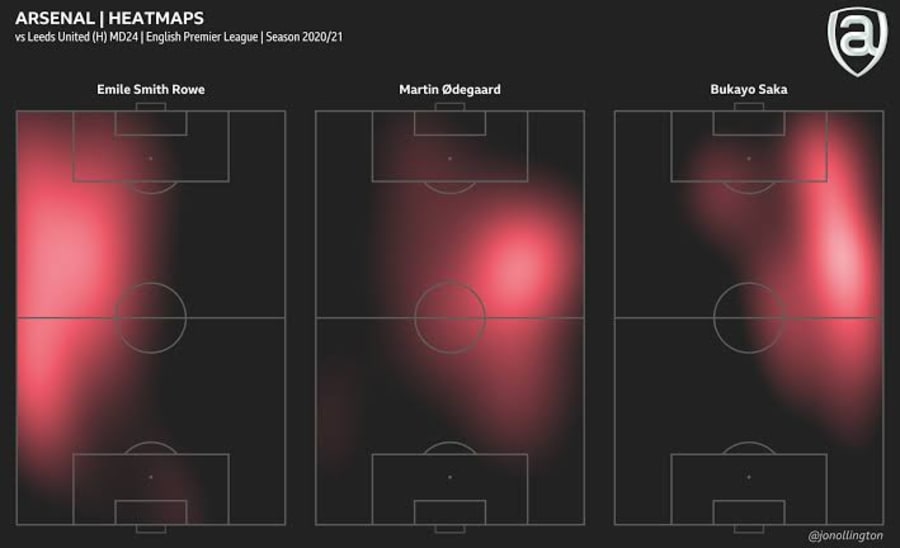
Another issue is that Odegaard and Saka like to take up similar positions as illustrated in this image from Joe Ollington (Twitter @jonollington) Via arseblog.
COMPARISON TO OTHER TARGETS:
Since Ødegaard only played 14 games in the PL, the sample size is not adequate. Maddison and Aouar are the rumored targets. So let’s take a look at their stats from 19/20 which was the breakout season for all three.
Ødegaard Played the number #10 role in a 4-3-3. Maddison also played a similar role in a similar setup but started on the left side of midfield. Aouar occupied left midfield and central areas in a 3-5-2.
GAMES PLAYED:
Ødegaard played 31 games and had 29 starts. Maddison had the same number and Aouar played 25 games while starting 23.
GOAL CONTRIBUTIONS:
Ødegaard had 4 goals and 6 assists. Maddison had six goals and 3 assists while Aouar had 3 goals and 4 assists.
PASSING RATES:
Pass completion rates were 80.9%,76.6% and 84.7% for Ødegaard,Maddison and Aouar respectively.
SHOT CREATING ACTIONS:
Maddison had 168 shot-creating actions, Ødegaard had 116. Maddison however had 23 more dead-ball chances to take.Per 90, Ødegaard’s goal creating actions was 0.53, Maddison’s was 0.41, and Aouar’s was 0.46
DEFENSIVE CONTRIBUTIONS:
Defensively Ødegaard made 28 tackles and won 18. Maddison made 56 and won 39. Aouar made 28 and won 19. Per 90 Ødegaard had 24.2 successful pressures while Maddison and Aouar had 31.5 and 25.8 respectively. Ødegaard made 20 blocks while Maddison and Aouar made 21 and 19.
DRIBBLING:
Ødegaard attempted 94 dribbles with a success rate of 67%. Maddison attempted 83 with a success rate of 67.5% and Aouar attempted 104 with a success rate of 62.5 %
MISCELLANEOUS:
Ødegaard was the most progressive ball carrier out of the three. In Aerial duels, Ødegaard outperformed Maddison.
In the 20/21 season, Maddison’s goal output only improved marginally to 8 goals and 5 assists despite playing 31 games and starting 24 of them. However, the injury did curtail that season, so this might not be the best estimate.
His defensive contributions also went down but injury likely played a part there as well.
CONCLUSION:
At 35m, it’s pretty much a risk-free deal. Ødegaard would greatly improve an Arsenal side that is in dire need of creativity. It would also mean that Smith Rowe moves to the left where many say he is more effective.
With Arteta rumored to be moving to a 4-3-3, Ødegaard would be a good acquisition. He can line up as a right midfielder moving into the 10 positions in a 4-3-3 in attack and start as a traditional 10 in a 4-3-3 when opposite teams press.
When it comes to the eye test, Maddison is more flamboyant and exciting and the rumours about him certainly excited many including me.
However, there is also the argument that Maddison’s stats are inflated by the number of set pieces he takes.
Odegaard offers more control but it would be favorable if he could be greedier and shoot more while also releasing passes at a quicker speed. At 22 though, this can be greatly improved.
I would like to end this article by saying that Ødegaard is by no means a poor signing and has an extremely high ceiling. Players like Saka are quite intelligent and will be able to adapt to his right-hand side preference.
However, signing only him would be a job half done. Arsenal need to sign a mobile striker who can get in behind the defense to complement his passing. Another point to note is that for the price quoted for Maddison, we would have to spend upwards of 60m and still need a striker because his goal threat alone does not elevate the needs of the team.
Ødegaard’s best traits come out in a 4-3-3 and in such a set up the presence of Thomas Partey is absolutely vital. So, I hope his injury worries are done. Partey-Lokonga- Ødegaard would be an excellent midfield trio.
At the price quoted, Ødegaard is a very good buy. It also allows the team to sign players like a Striker, right-back, or goalkeeper while also adding to the attack a midfielder who knows the club and its players.
Thank you for reading. Any feedback is appreciated.
Follow me on Twitter @ChennaiGunner for opinions, analysis, and everything Arsenal.