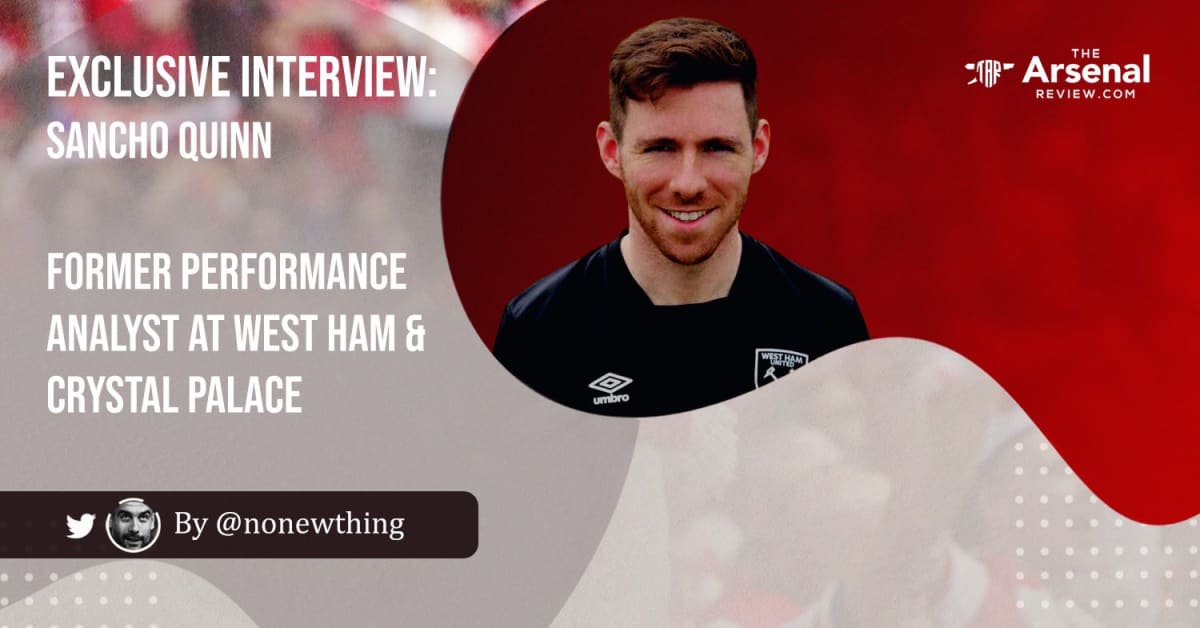
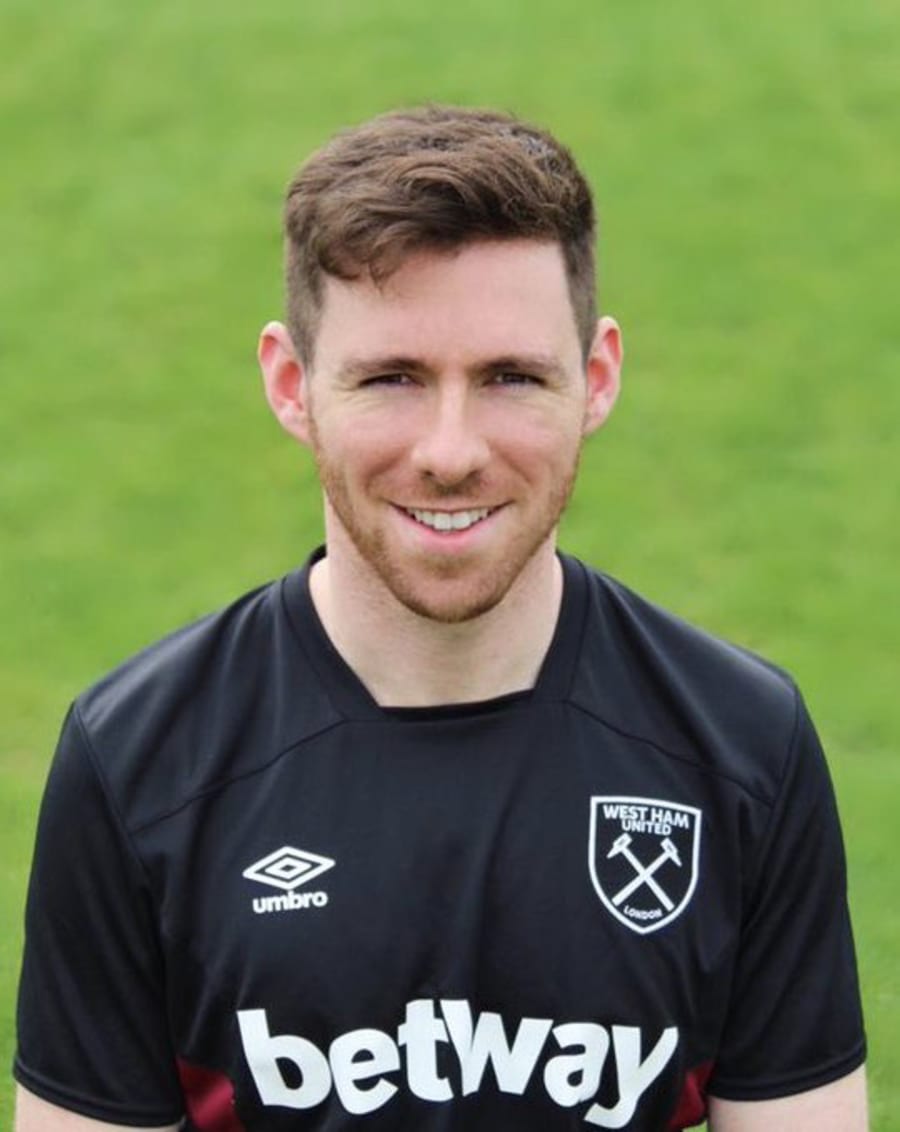
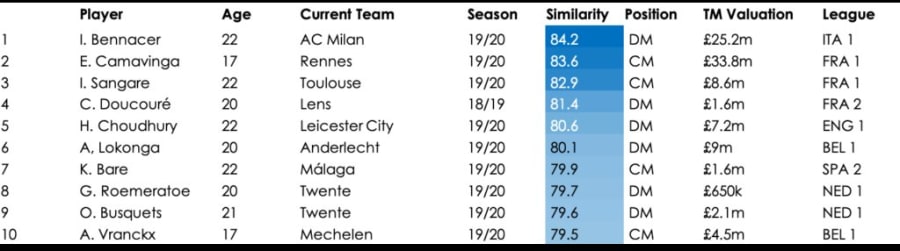
In April 2020, 71 days before the transfer window officially opened, Sancho Quinn published a series of blog posts where he tried to find Arsenal a new centreback. One of the names he recommended was Gabriel Maghalaes. The other? Sven Botman, then at Sc Hereneveen. Both have since shot up to become some of Europe’s hottest defensive properties, with Gabriel officially signed to Arsenal and Botman replacing him at Lille. Not satisfied with his work, the blogger went on to try and find the next Fabinho, coming up with a list that included the likes of Albert Sambi Lokonga and Cheick Duocore.
Quinn, who was a performance analyst at West Ham and Crystal Palace and now works at Metrica Sports, says he has no idea if anyone at Arsenal actually read his posts. However, it wouldn’t be a surprise to him as other people working at other clubs have reached out. In the course of research for another article about data analytics and the Arsenal rebuild, I stumbled across his blog and reached out on Twitter. He was gracious enough to respond and we had a little chit-chat.
One of the key steps in Quinn’s scouting process was the use of a similarity model. As he noted in his blog, this model was “…built in Python,” and “…clusters players on a number of stylistical variables before using the Euclidean Distance to find the most similar players to the chosen player.” In other words, “…this model skims through a database of thousands and thousands of players and shoots out those most statistically similar to the chosen player.”
Pretty neat, huh?
Quinn says that it is important to note that the model is about style not quality. It’s less about how well a player performs certain actions and more about how frequent some types of actions are for them compared to others. So, if, say Jack Grealish executes certain types of actions frequently, his potential stylistic replacements have to also show up in those same areas.
When I asked Quinn if he thought his model could be improved, he was positive. Apart from having better data—physical and pressures data, in particular—similarity models could do better at determining team style, which can affect output. As he put it, “The majority of data analysis around recruitment is based around player quality, who’s making the most xG or xA per 90? who’s making the most key passes? And so on. One of the most difficult things to measure is how those outputs will translate if a player moves from team A, to team B, which might have a different style of play and might ask different things of their players.”
Quinn, who studied at the University of Worcester, managed to work around this by adding a second layer of examining percentile ratings in certain key metrics per position. That simple filter helped produce much better results. Having said that, the former performance analyst believes it could be more robust and calls for caution. “You have to be careful that what you are measuring is what you think you are measuring, though. In reality, I came up with the parameters based on what I thought was a good proxy for playing style. In an ideal world, you would sit down with the coaching staff initially to agree the ‘factors’ or metrics that go into the model. This level of collaboration between the data people and the ‘football’ people is coming in clubs, from what I can see.”
Players in outfield positions generate plenty of useful data in a variety of metrics, making them easier to analyze, but what about goalkeepers? Does Quinn see more data-driven recruitment of talent in this department?
You could almost sense the pause in his reply. “Keeper analysis is still quite immature, from what I’ve seen. There’s less certainty on what metrics actually indicate quality for keepers and then you have team effects that can play a huge role. The stats of a keeper are always going to be impacted by how many shots they face, particularly how many high-quality shots.” Quinn’s initial pause had given way to something else here: a far-distance look of contemplation. This was something he’d given much thought towards.
“Looking at player performance relative to their teammates is a way of highlighting statistical outliers who may be able to play at a higher level. This is an approach Ian Graham of Liverpool has spoken about recently. Perhaps something similar to this could be modelled for goalkeepers. The problem here of course is that the sample size can be tiny. The number 1 goalkeeper might play 90+% of the minutes and you only have a number 2 goalkeeper who barely plays to compare them with. Perhaps some comparison with other keepers who play in teams with a similar playing style, who allow a similar amount of xG and concede similar types of chances, could be interesting to explore.”
Quinn who is a huge Arsenal fan is sure that some data analytics was present in the signing of Aaron Ramsdale. “Arsenal are a club with one of the longer standing and more established data departments in Europe… I’m sure there was some data analysis that played a role in the signing of Ramsdale.”
Even if there was some data-led insight into the signing of Ramsdale, the transfer seems to ultimately be a triumph of traditional, live-scouting. His bravery, concentration and presence has been an important asset to Arsenal’s defence. Those qualities, important as they are, won’t necessarily show up in data. That’s why the London-born analyst thinks that live-scouting should never be taken out of the equation. “Why limit the information sources you’re using when you’re trying to mitigate the risk of hugely expensive transactions?” He raises his hands, and shrugs. “Reduce unnecessary travel costs and do more work remotely via data and video scouting, sure, but there is still a lot of valuable information you can only get on a player live, rather than on video or in data.”
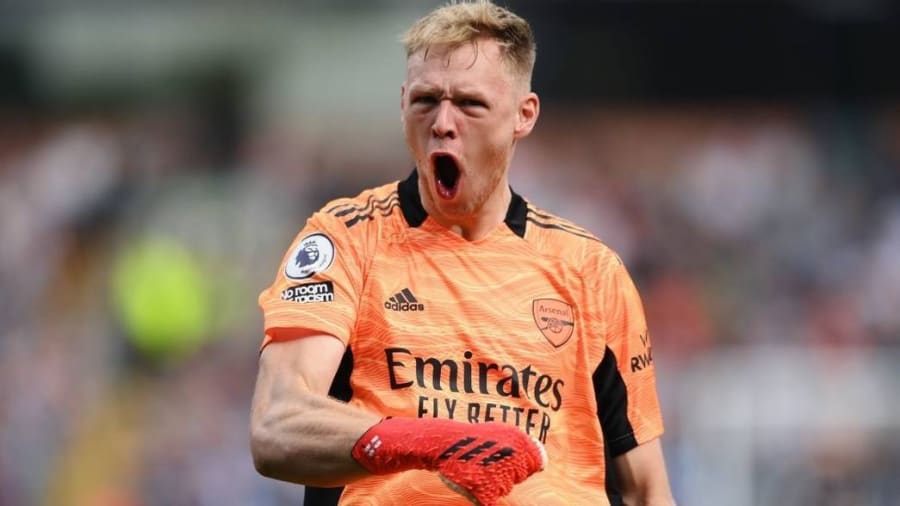 “Ramsdale’s mental qualities are important” [arsenal.com]
Arsenal had a somewhat curious transfer window. While they spent the most in transfer fees in England, they also had an average of 24 million euros spent on 6 players from the Belgian Championship to the English second-tier. Agents interviewed by The Athletic deemed it one of the worst windows in England. For them, it was too young, too analytics-driven, too continental. But perhaps that was the point. Quinn says that the arrival of data analytics in soccer has led to an expansion in player recruitment pools. “Teams in Europe had their traditional markets they would get players from and this net has become significantly wider. Players in less well-known leagues are easily flagged in data now where they may not have become targets before.”
All of this has however led to a new problem of who gets there first. “Although they have more resources, it’s arguably a harder job than ever for recruitment analysts. As soon as a player is a stand-out in their league, it’s almost too late. They’re known by everyone. In this way it’s a race to get there first.”
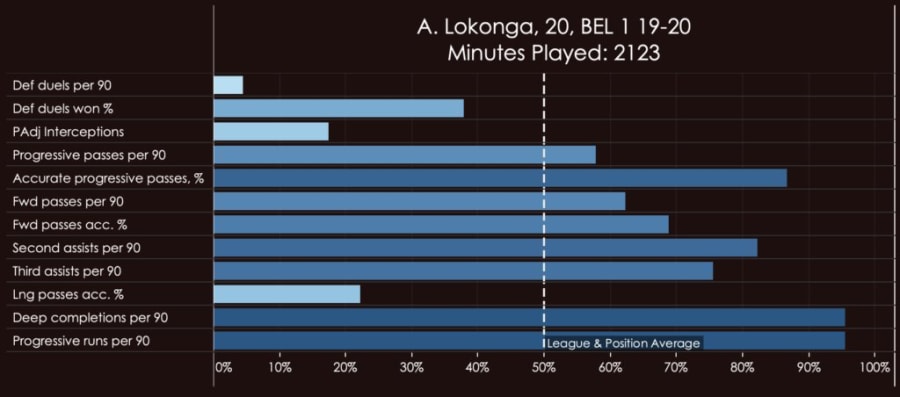 Lokonga Stats: “Lokonga Was a Standout”
This is however not a fatal problem if you have access to industry-leading data. Quinn’s employers work in that cutting-edge area. “What the computer vision technology of a company like Metrica allows you to do is get tracking and physical data from leagues at almost any level, leagues that may not even yet have a reliable event data pipeline. That’s where an obvious edge lies, having data that other clubs don’t have. And I think, pretty exciting.”
The excitement doesn’t end there. “Increasing accessibility of data will lead to a boom in the emergence of player talent but also in staff talent. The more data that is publicly available, the more talented analysts can emerge from the community. There is a huge amount of talented data analysts/engineers from Asia and Eastern Europe for example. So the net for staff talent to come and work at football clubs is widening as well.”
Quinn’s work has taken him to clubs and sports tech companies. His diverse experience despite being just 29 years of age affords him unique perspective into what it is like to work in both scenes. You can tell he misses working in a club, the week-to-week thrill of contributing to a win on the weekend, but not much else.
“Working in the sports tech space, often the money is better, less evenings and weekend working and a bit more flexibility in how and when you work. Of course you miss being part of a winning side on match day. The job satisfaction can be huge working in the club setting but, as much as it can be a brilliantly fun job, it is very demanding.” It is a testament to the oft-terrible working conditions at soccer clubs who spunk millions on transfers but can barely assign a decent budget for departmental staff. You can almost smell the relief—and disappointment—in his words: “I’m very fortunate to have experienced both and now get to help analysis departments in small ways from a distance, rather than being on the frontline.”
In Quinn’s opinion, that is not the only thing that needs to be fixed in clubs. “There’s still a disconnect between the data guys and the football guys at many clubs and many data departments in clubs are still very immature and early in their establishing processes phase.” More integration is needed. But an area where clubs are certainly doing well is the incorporation of physical data into training and recruitment.
“With the advent of tracking and physical data for scouting, absolutely it’s a very useful way to mitigate risk in transfers,” he says. “Clubs have been doing this internally for years with GPS data and sports scientists managing player physical loads, flagging when they are at a higher risk of injury and ultimately trying to protect players, and keep them in peak physical condition for longer.”
This was the case for Pierre-Emerick Aubameyang when Arsenal were scouting him at Dortmund and decided to give him a bumper contract extension. His physical data has him ahead of his cohorts in the game.
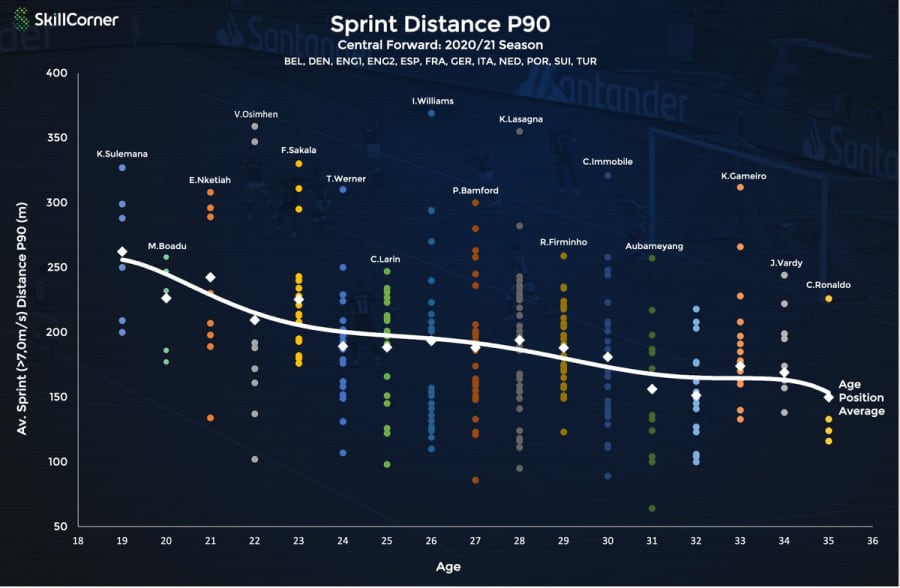 “Aubameyang is a Physical Standout”
At this point, I wondered what Sancho Quinn thought of the Arteta rebuild and he indicated great support for it. “I was 100% behind Arteta from the get-go. On paper, it was hugely exciting – student of Guardiola, young coach, speaks very well. Everyone wanted it to work but we had a really tough period and I wasn’t sure he was going to last. At the time of writing, we are two points behind a very good Liverpool side (although -20 compared to their goal difference, which is pretty remarkable). This represents an impressive turnaround and long may it continue.
The main thing that has changed for me is simply the quality of the players. The recruitment team have done a great job recently and the XI’s we put out now are much stronger than they were 12 or 18 months ago. Gabriel and Lokonga are great and very much AnalysisID approved. Ben White is clearly a good footballer. Tierney is great, Tavares looks a very astute signing. Ramsdale looks a great signing. Tomiyasu, while not a world-beater is a very solid player. There was a period where I would look at our starting XI’s and think… I don’t actually like many of the players in that team. With Saka and Smith-Rowe thriving also, there’s a lot more to be positive about now.”
 Tomiyasu: “From Japan to Belgium to England”
Well, given the rumors that Arsenal are looking to strengthen in the winter window, would our reclusive analyst be willing to give more tips to the recruitment department? “I hope so, it’s good fun and I’d like to find the time to do some more. It’s also a good excuse to watch a load of football from more obscure teams, something I don’t really have to do anymore for work.”
However, the Metrica Sports manager finds copyright infringement strikes on the video clips he attaches to his recruitment reports quite annoying. “Without the video analysis also, I don’t think these blog posts are half as interesting. I kind of get that broadcasters/leagues want to protect their ‘property’ but it is frustrating to put in a lot of work and then for a series of clips to be taken down. But yes hopefully, some more blogs will be written in the near-ish future!”
There was one last question for Mr. Sancho. How did he get here and how could others get here, too? You could almost hear him scratch his chin (he has a goatee that makes him look a little like Lionel Messi). “Mine was a bit of a weird one, I was quite fortunate really to land at Metrica, so not sure I’m the best person to advise on getting a job at a sports tech company. I also don’t think there is one correct way to get a job in sports. I’ll answer this through the hypothetical of if I was 17 again and my ambition was to work at a football club, what steps would I take… Get a sports science degree, do coaching badges ideally to Uefa B or beyond, a Masters degree in sports analysis/data would be important, learn Tableau, learn programming as well as SQL, Python/R, blog, do some public work, create a portfolio of things you’ve done, get feedback, improve. Again, these are not the only way, or even necessarily the best way, but this combination of tactical understanding of the game of football, plus strong data skills, would make you extremely attractive to clubs. The degrees, rightly or wrongly, appear on almost every job spec for roles in football.”
Sancho Quinn has done extremely interesting work on his blog, AnalysisID, which is still relatively light on content. He’s tried to find the Grealish replacement, the Fabinho replacement, centrebacks for Arsenal, tried to identify players who might be suited for conversion into another role—you get the idea. Right now he works for fittingly innovative employers in Metrica Sports who have changed and are changing football with tools that transform video analysis visualization into a breeze: annotations, spotlights, speeds and distances—everything—at a click. You just upload the match video, choose what you want to see and Metrica Play does the rest. They have also made a Play Basic version available, which is free, and capable of working with any video of any match, from anywhere.
From Santos to Stockport, everyone works with Metrica Play now. And with the Play Basic, Quinn’s employers are empowering nonprofessionals with access to the same tools that Barcelona analysts use. Founded by PhD students who had bonded over Lionel Messi in an Amsterdam pub, the company has stayed true to its roots and plans to bring the cutting edge to every country. This is part of Quinn’s remit: getting in touch with clubs/organizations to show them what Metrica can do. In this way, Sancho Quinn wants to change not just one club but the whole world one at a time.