Granit Xhaka, a man who continues to divide opinion amongst the Arsenal fan base. Many believe the 29-year-old flatters to deceive, whilst others hold the former club captain under high regard. Certainly, Mike Arteta is in agreement with the latter and it’s clear why.
The Spaniard advocates possession-based football, with emphasis placed primarily on building out from the back and moving through the thirds in an efficient manner.
With Kieran Tierney deployed effectively as a left-winger, the former Borussia Monchengladbach man is given the responsibility of playing forward passes towards the dynamic Scotsman and statistically, Xhaka’s impressive progressive ability is well supported.
On average, Xhaka completes 7.07 progressive passes, 10.28 long passes and 8.73 passes into the final third per 90 minutes, ranking him in the 95th, 92nd and 97th percentiles respectively when compared to other central midfielders across Europe.
The Swiss international is crucial to the team’s overall functionality and despite a small sample size, both he and Thomas Partey have blossomed in a partnership, with the Gunners’ eye-catching north London derby victory an example of how the two complement each other in the engine room.
But with Xhaka suffering an ankle injury that rules him out of action until January, uncertainty now arises regarding how the Gunners will cope in his absence and it’s fair to say that they didn’t show encouraging signs in their last outing, away at the Amex stadium.
Arsenal struggled to eliminate the aggressive 3-5-2 pressing shape Brighton manager Graham Potter utilised, which forced goalkeeper Aaron Ramsdale to regularly go long.
Unfortunately, the away side had insignificant success with this avenue as well since the former Sheffield United stopper couldn’t hit accurate passes upfield and into areas where teammates could pounce on second balls, largely because of the unfavourable weather conditions presented.
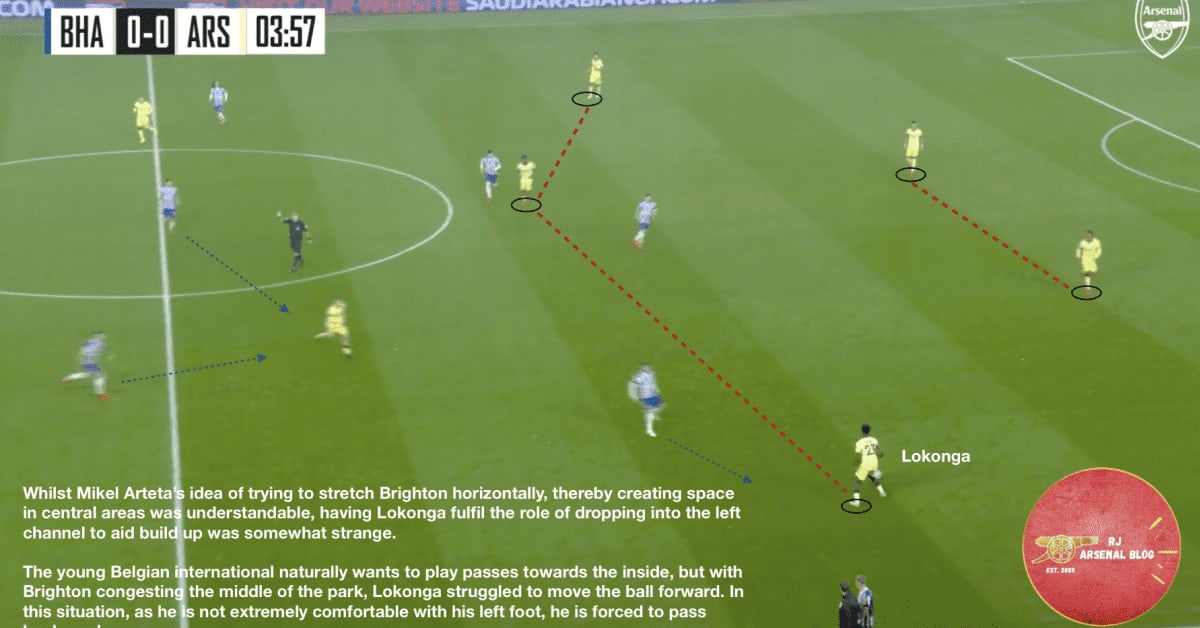
On paper, Sambi Lokonga partnered Partey in the double pivot, but the role the young Belgium international was given wasn’t one a midfielder would typically envisage.
On the day, Arteta opted for a 2-3-5 in possession structure, with Lokonga positioned very wide as a left centre back during the first phase of play, which created two glaring issues.
The first was that it left Partey isolated in the middle of the park and the other was the struggles Lokonga had in distributing the ball forward in tight spaces towards the left flank.
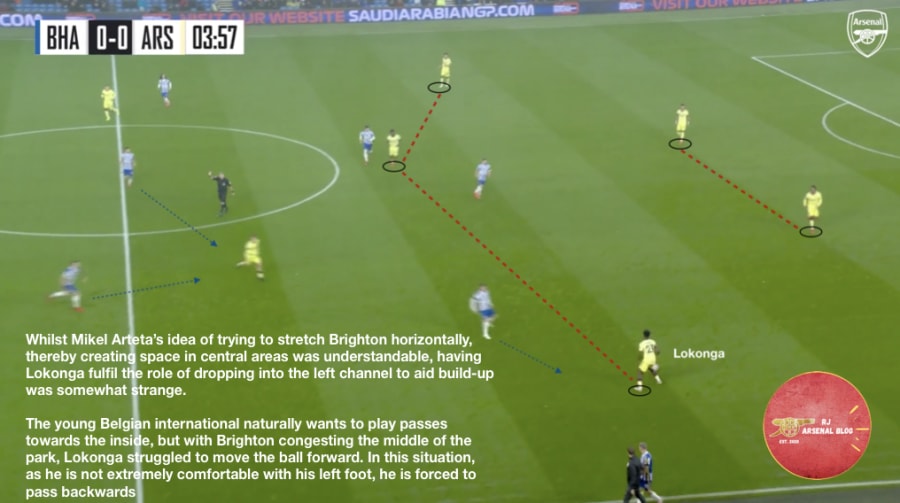
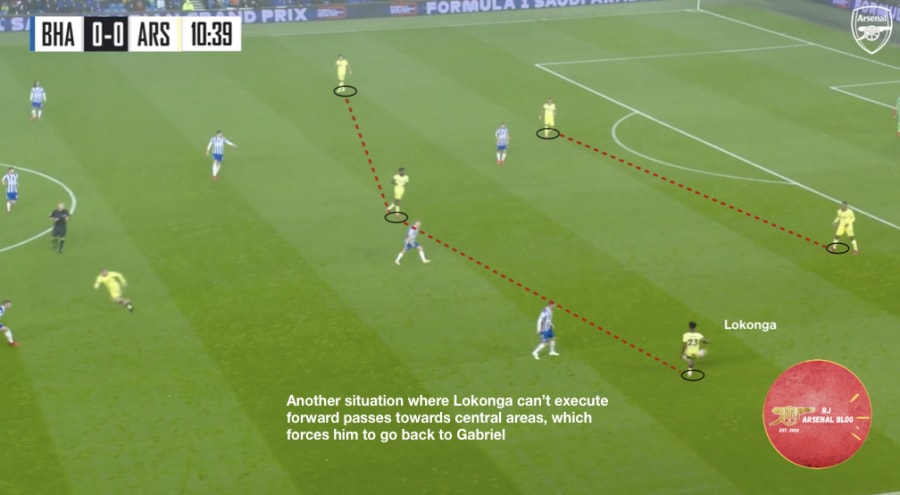
Because Lokonga is right-footed, the former Anderlecht prospect naturally cuts inside and play passes into central areas, but with Brighton congesting these zones with three energetic midfielders, passing lanes were eliminated, thereby stifling ball progression.
Furthermore, with the 21-year-old occupying this area of the pitch, he was always receiving the ball in unfavourable areas, preventing him from riding challenges on the half-turn and evading pressure – aspects he excels in when operating on the right side of a two-man midfield.
The tactical principles Arteta utilised were somewhat strange as the Spaniard has persisted with a 3-2-5 (3-2-2-3) shape in recent times, with the right-back dropping into the backline to form a three (Tomiyasu in this case), which reduces the distances between the two in midfield.
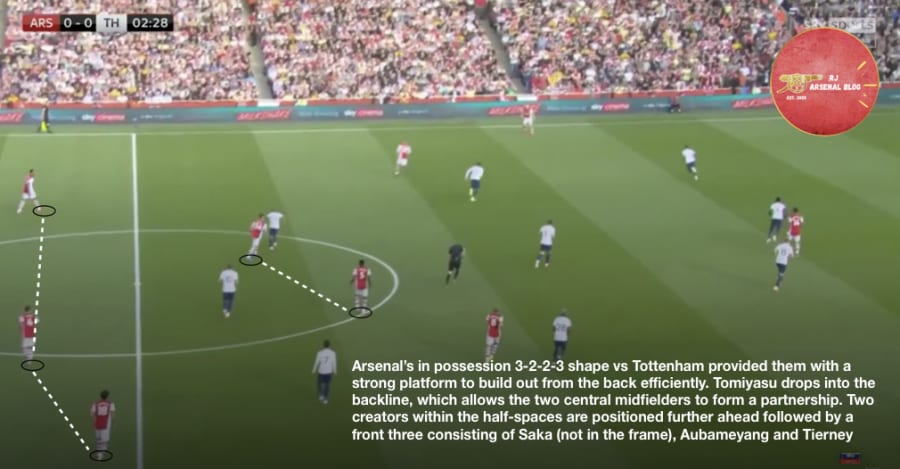
Certainly, he should revert back to these tactics as it plays into the strengths of key individuals, but the question now revolves around how Arteta can adapt his team accordingly against top pressing teams using the current options he has at his disposal.
Whilst not a glamorous solution, including Mohamed Elneny back into the starting eleven is arguably the best way to unlock Partey.
With 17 Premier League starts for the Gunners last season, significant faith was placed on the Egyptians shoulders as Arteta was confident in his ability to execute the instructions given and act as the deepest midfielder.
Covering space, recycling possession and ball retention skills are assets within Elneny’s game, all of which are qualities that prevent Partey from being restricted in a defensive role and with this dynamic, Arteta can adopt interchanges during the build-up phase.
Whilst the typical 3-2-5 shape is easily retained with these two together, as shown in the frame below, the advantage of this partnership is that both are comfortable at collecting the ball within their own box, with the second frame illustrating Partey splitting the two central defenders and receiving possession from Bernd Leno within the first line of defence.
This essentially allows the right back to push forward and move alongside the other central midfielder.
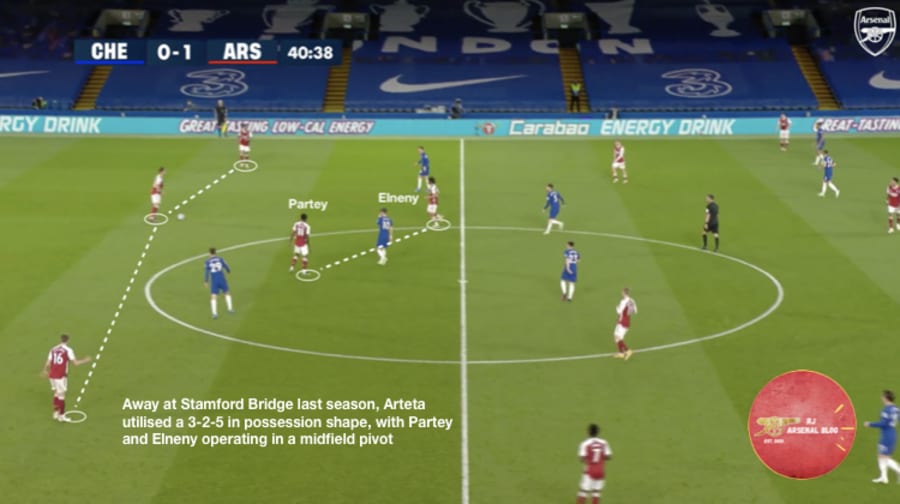
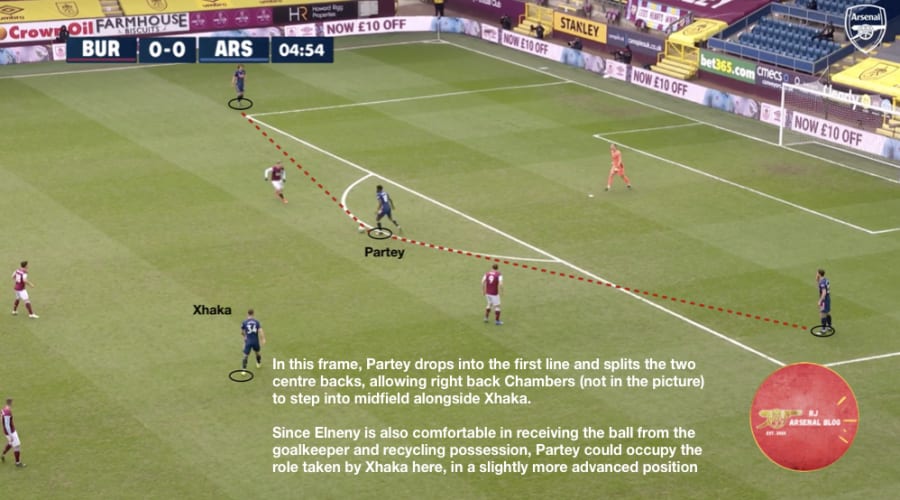
Since Elneny is also a composed figure in pressured situations and can circulate the ball towards the flanks, Partey can act as the more advanced midfielder (Xhaka in the frame shown above), with license to drive forward.
The opportunity to rotate between different shapes in build-up can confuse the opposition and this particular partnership would give the Gunners a degree of flexibility.
Obviously, the fundamental flaw Elneny possesses is the lack of penetration in his passing, which hinders the speed in which Arsenal can transition from defence to attack.
It’s a significant frustration Gooners across the globe have, hence why many prefer Lokonga because of the youngster’s superior ability in picking out teammates in pockets of space further ahead when acting as an out and out midfielder.
The concerns with Lokonga however revolve around the fact that he prefers the right-hand side, has clear defensive deficiencies and is still incredibly new to the Premier League.
There’s no denying his talent and potential, but to give him significant responsibility right now is a risk.
What’s worth mentioning is that regardless of whether it’s Lokonga or Elneny, the importance of Gabriel Magalhaes’ ball-playing ability rises following Xhaka’s unfortunate setback.
Whilst Ben White is notoriously known for carrying the ball upfield and distributing it in multiple ways, Gabriel has typically been labelled as ‘limited’ in possession.
But the Brazillian has shown clear improvements this season so far in both decision making and the execution of his passes, with the two frames below demonstrating this.
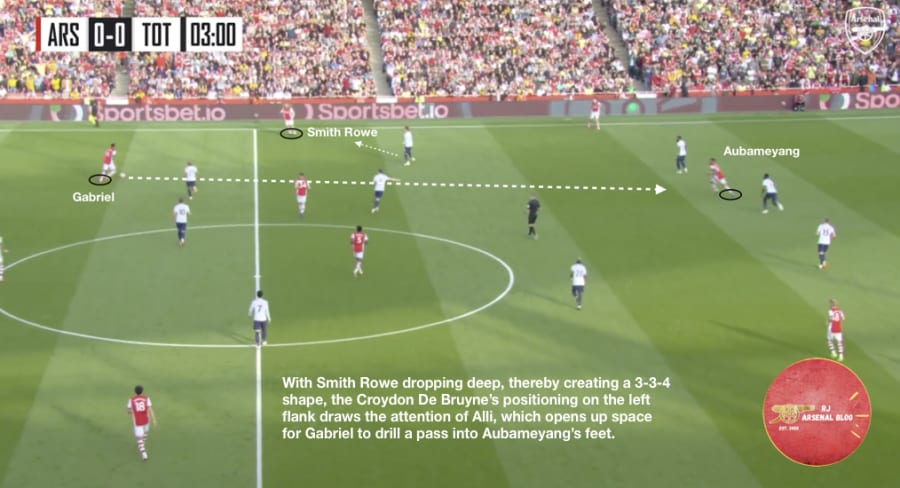
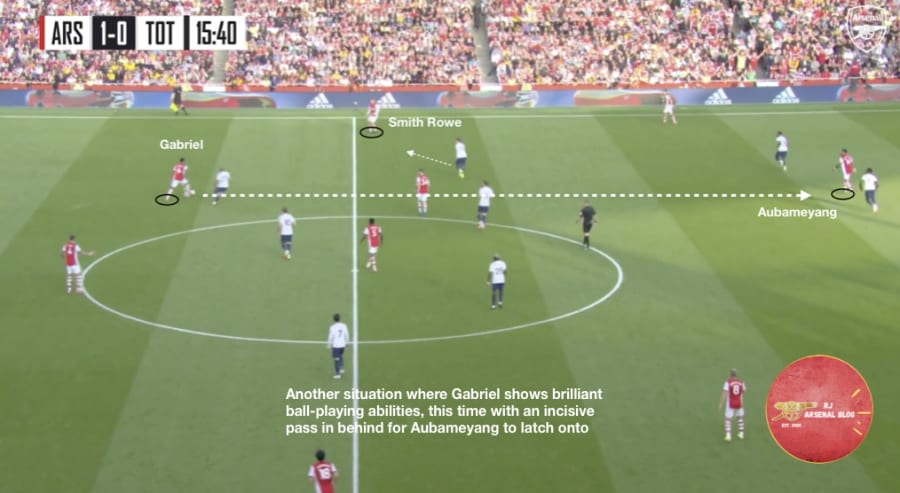
Having Emile Smith Rowe drop into left-back, thereby creating a 3-3-4 structure is a solution the Gunners can use to bypass intense pressing units.
With the Croydon De Bruyne regularly drawing the attention of Dele Ali, a passing lane into Pierre-Emerick Aubameyang’s feet was opened and Gabriel threaded the ball between the lines to his captain on multiple occasions.
Arsenal’s number 6 will need to maintain consistency in the quality of his distribution, particularly towards the left channel if the Gunners boss does favour two right footers just in front of the backline.
Alternatively, Arteta could resort to principles used in the 1-0 victory against Burnley at Turf Mour.
Martin Odegaard dropped into central midfield, alongside Partey and was tasked with the ‘Xhaka role’ of giving Tierney licence to bomb forward and delivering forward passes towards the flanks and through central areas.
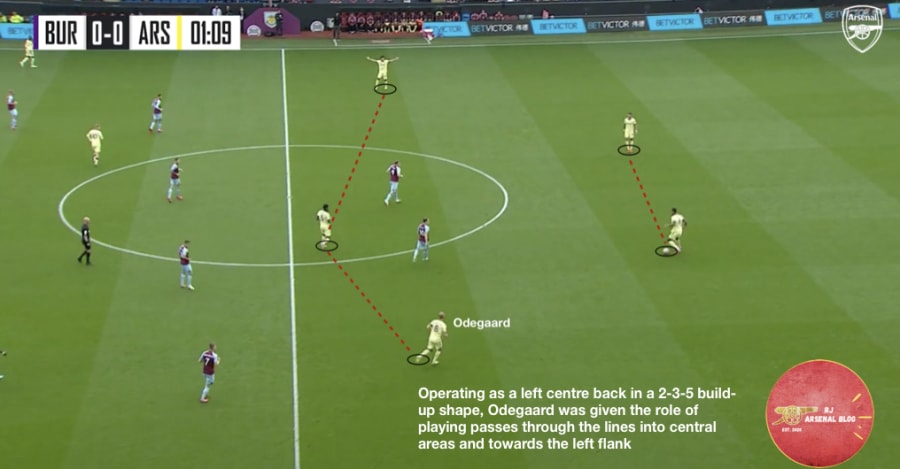
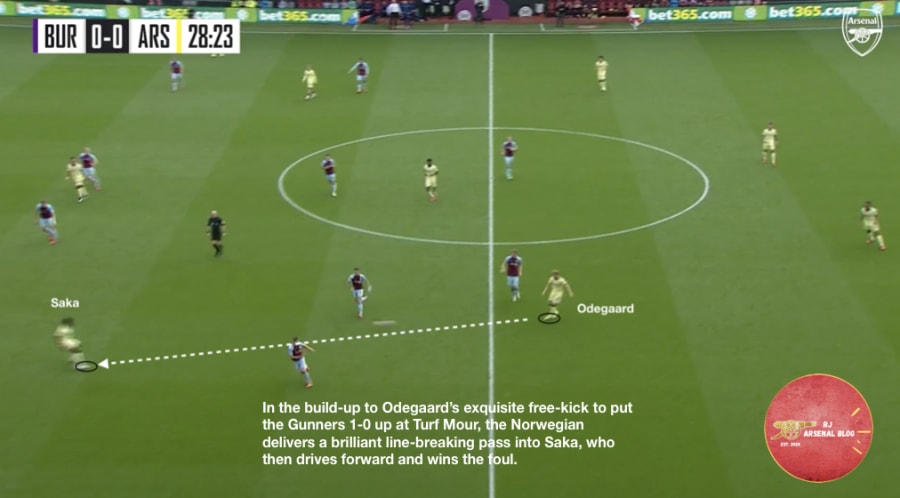
Greater balance is arguably established with this combination since having Odegaard covering the left space ensures desirable passing angles are achieved, which is why the decision to select Lokonga ahead of the former Real Madrid star in central midfield at Brighton was rather baffling, especially when considering the latter would have naturally been able to play passes towards the left channel.
Performing the role of a controller isn’t new to Odegaard as the Norwegian regularly drops into deeper areas within the right half-space when operating as a number 10 in order to facilitate ball progression.
Furthermore, selecting Odegaard as a pivot player would give Arteta the opportunity to incorporate an additional attacking option, which in theory should help increase potency in the final third.
But the disadvantage with the 22-year-old playing in this position is his inability to provide transition control along with the fact that he simply can’t act as the team’s anchor, which results in Partey being relegated into sitting just in front of the centre backs, with minimal license to drive forward.
Each solution highlighted has its benefits but also glaring weaknesses.
From my perspective, balance is crucial and a footballing aspect that breeds sustainability.
It’s pivotal that Partey is in a situation where he can be at his best as Arsenal’s chances of winning games and producing top performances increase substantially when their most talented midfielder is surrounded by the right environment and personnel.
Whilst the former Atletico Madrid midfield warrior is capable of playing as a lone 6, as previously mentioned, he is constrained in an attacking sense in this position.
Instead, he is tailored to the right-hand side of a double pivot and is far more influential when given opportunities to influence proceedings at both ends of the pitch.
This is why Elneny seems to be the ideal option for the short term, despite being less talented and far more limited when compared to the likes of Odegaard and Lokonga.
But what’s clearly apparent is that the north Londoners need to analyse the January market and identify ways in which they can bolster their midfield.
Hope you enjoyed the read! Please comment below as I’m intrigued to know your thoughts.