In the summer 2019 transfer window, Arsenal announced the signing of Nicolas Pepe from Lille for a club-record fee of £72 million. With the talented forward bagging 23 goals and 12 assists during his last campaign for the French club, Arsenal fans were expecting him to hit similar numbers for their beloved club.
But instead, the 24-year-old at the time endured a turbulent start to life in north London. Under former head coach Unai Emery, Pepe struggled to attain regular game time along with simply not suiting the style of football deployed.
On numerous occasions, the Spaniard selected three defensively more minded midfielders, meaning that Pepe was tasked to frequently receive the ball from a deeper position and essentially facilitate creativity, which isn’t a role he is comfortable with. Arsenal’s number 19 thrives in situations where the ball is played in front of him and into space, but in Emery’s setup, the chances of him thriving were always going to be thin.
Things didn’t really get much better under ex-Gunners legend Freddie Ljungberg either. Despite the Côte d’Ivoire international impressing in what was an outstanding display against West Ham – scoring and assisting at the Olympic stadium – he still wasn’t able to cement himself as a first-team starter.
The arrival of Mikel Arteta however allowed Pepe to apply the reset button, with the Spaniard reiterating that everyone would be given a clean slate and wouldn’t be assessed on their previous history.
Initially, the former Arsenal captain favored Hale End graduate Reiss Nelson in his first two league games in charge, but Pepe was finally given an opportunity to impress in the following fixture against Manchester United, and he didn’t disappoint – scoring the opener in a 2-0 victory at the Emirates.
Since then, he went on to produce a string of eye-catching performances just before lockdown against the likes of Newcastle and West Ham, along with shining towards the latter stages of the 2019/2020 campaign.
Struggling in the hybrid 3-4-3
Going into his second season in England, there was growing optimism that Pepe would finally begin to start justifying the heavy price tag placed on his shoulders, especially when considering the promising form he showed in the FA Cup, making crucial contributions in both the semi-final and final of the competition.
But to the surprise of many, Arteta predominantly selected new signing Willian ahead of the £72 million forward during the first half of the season.
Despite the Brazilian impressing on debut against Fulham, the former Chelsea star certainly wasn’t justifying his selection following a lengthy string of poor performances – which came at the expense of Pepe, who saw most of his minutes restricted to cameos off the bench in the Premier League or starts in the Europa League’s group stage fixtures.
There is the argument that the former Lille man wasn’t executing the fundamentals to the required standard, particularly with his underwhelming off-the-ball work rate, but the irregular minutes he received definitely stifled his ability to develop any sort of rhythm within his game.
The other problem revolved around systematic deficiencies. Under the unorthodox hybrid 3-4-3, Arteta favoured heavy left-sided overloads when the ball was progressed into the opposition half.
In the final third, Kieran Tierney, operating as a hybrid left center-back and overlapping full-back, would effectively advance down the left channel, create width and deliver crosses into the box. The areas occupied by the dynamic Scotsman allowed the left wing-back, whether it was Bukayo Saka or Ainsley Maitland Niles to take up the left half-space with Aubamayeng drifting into a more central position.
As a result, the right wing-back was instructed to remain deep and join the midfield for balance purposes, ensuring that enough protection was provided in front of the centre-halfs.
With no frequent option of an overlapping right-back or a readily available number 10, this left Pepe in regular isolation. The fact that the 26-year-old is also very left-footed made it relatively easy for opposing players to double up on him and negate any influence he could potentially have.
Revitalized since the new year
On Boxing Day however a lifeline was handed and it came in the form of young academy graduate, Emile Smith Rowe, who gave Arteta the opportunity to deviate away from the hybrid 3-4-3 and move to a 4-2-3-1; a system the Arsenal boss began with when he took over back in 2019.
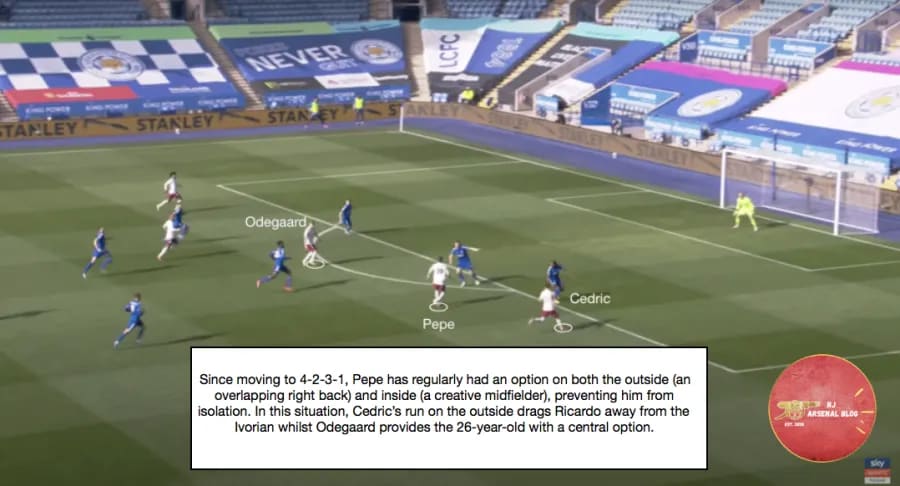
The Croydon De Bruyne’s ability to infiltrate space between the lines, drift out wide and attract players towards him prevented the right inside forward from holding the width and instead allowed them to occupy the favourable half-space.
His inclusion into the team along with the arrival of Martin Odegaard in the January window came to the delight of Pepe, who not only had a creator he could combine with but was also given greater freedom to roam rather than operating primarily as a touchline winger.
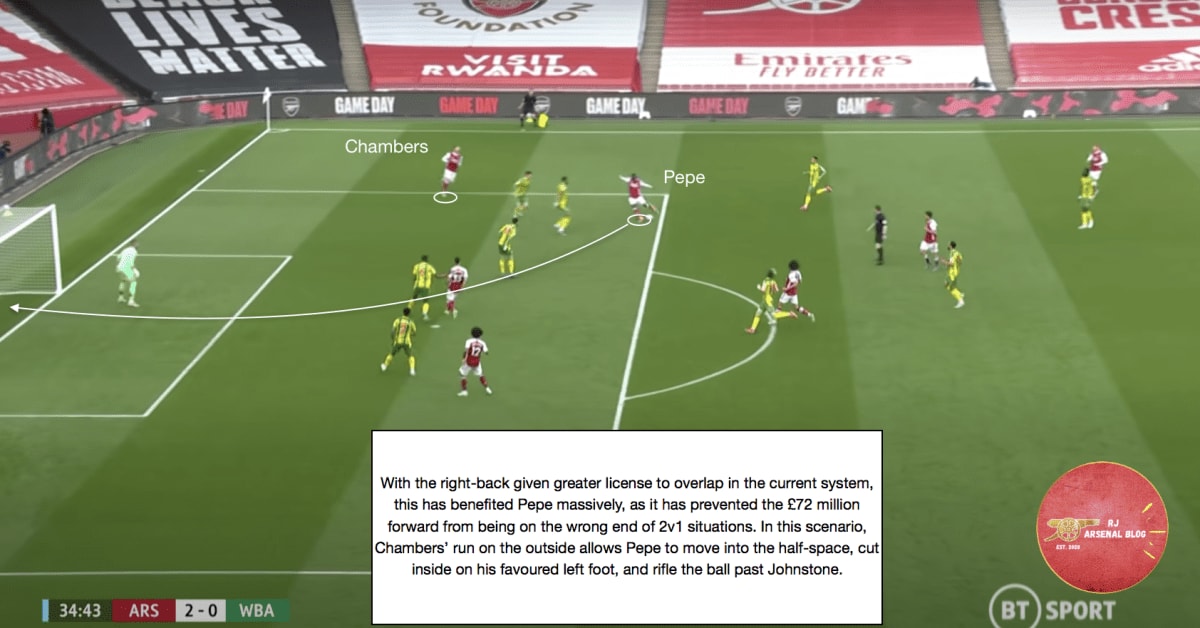
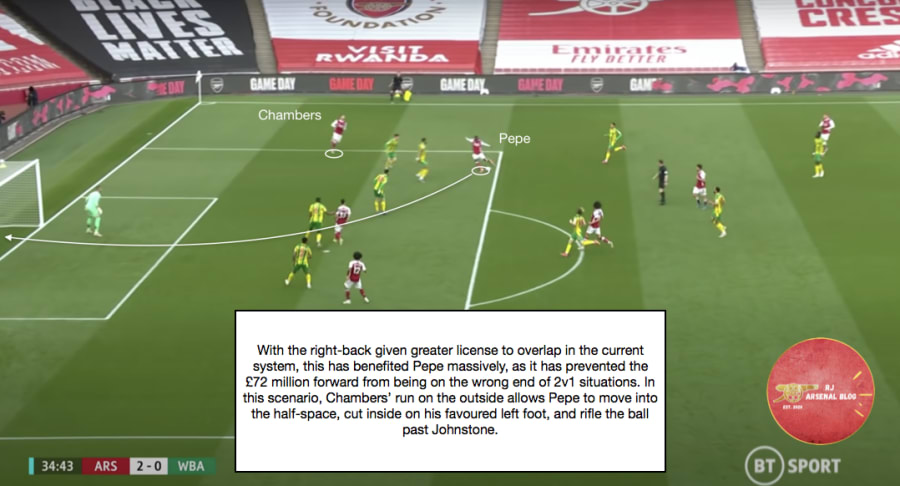
The other tactical tweak made since changing systems has been the role of the right-back. Calum Chambers has proved to be a key figure in the Arsenal manager’s 4-2-3-1, as the 26-year-old covers each aspect Arteta requires from his full-back to a more than adequate standard.
When attacking through the right, the Englishman will overlap rather than stay deep, which has benefited Pepe massively since it’s given him an option on both the outside and inside. The Ivorian struggles to hold the flank on his own, but once he has supporting players within close proximity to combine with, he is a serious threat as not only does this allow him space to cut inside on his deadly left foot, but it also enables him to showcase his strong dribbling skills against defenders in 1v1 battles.
Promise on the left-wing
The absence of Kieran Tierney forced Arteta to alter the dynamics since the Spaniard had no naturally left-footed back up full back in reserve. Many expected Bukayo Saka to deputise for the Scotsman, especially when you consider Arsenal’s player of the season performed this role to a high-level pre lockdown of last year.
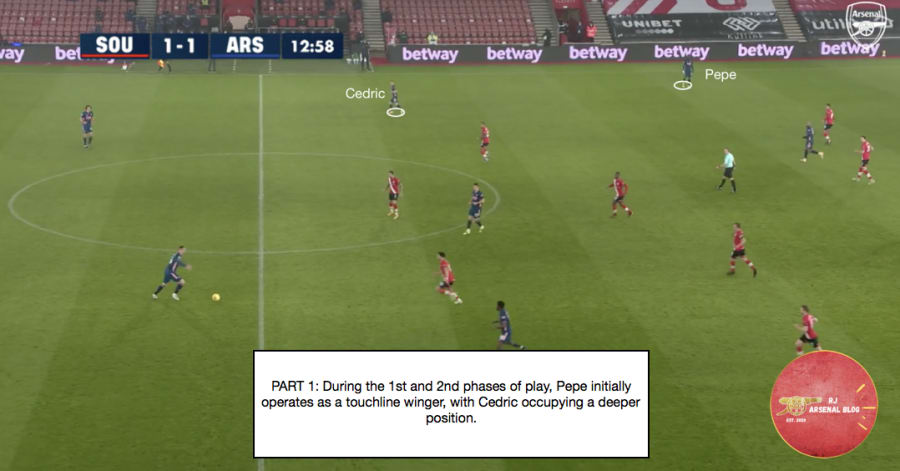
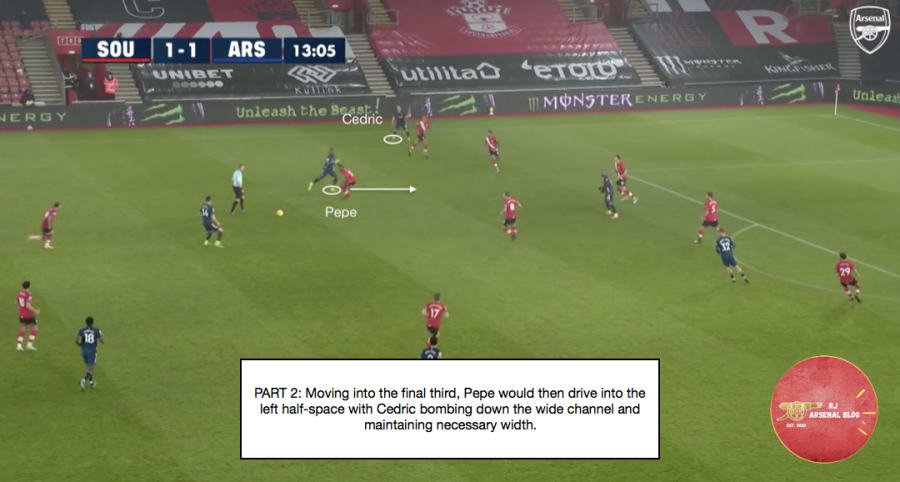
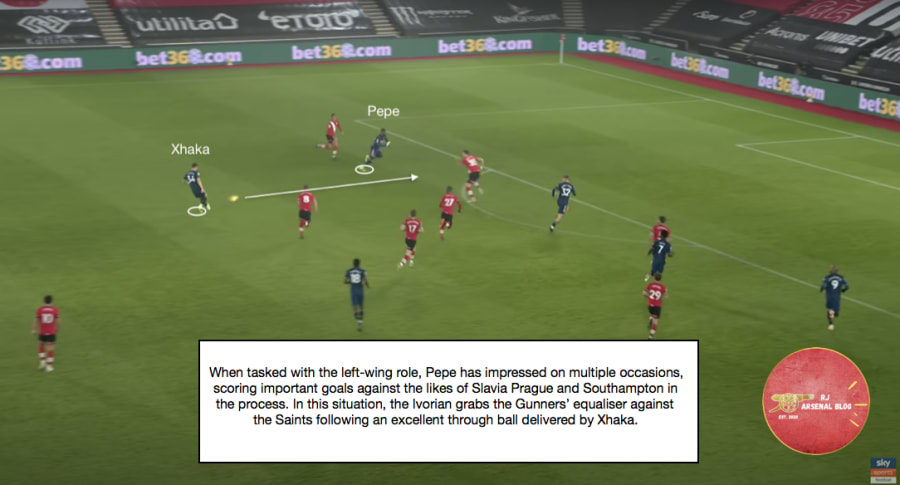
But it was Pepe who operated on left-wing, tasked with holding the width during the build-up phases before driving into the half-space and making darting runs in behind the opposition backline. From an individual perspective, he had great success in this role, netting goals against Southampton, Wolves, and Slavia Prague in the process.
Final thoughts
With 21 goals contributions in all competitions, statistically, it wasn’t a bad second season at all for the 6 ft 0 in winger, to say the least – in fact the evidence is there to suggest he is on course to having a stellar third season at the Emirates. What’s also worth noting is the significant improvements made defensively – an aspect that wasn’t apparent in his game during the early stages of last season.
The change in formation and personnel in certain positions has been the catalyst in Pepe’s upturn in form, and with Arteta looking increasingly likely to persist with the current 4-2-3-1, there is the expectation that the Ivorian will maintain productivity levels.
But no doubt there are areas he needs to improve upon in order to win over larger portions of the fan base, as many still aren’t convinced that he will reach his full potential here in England.
Arguably Pepe’s biggest weakness currently is the inconsistencies shown in ball retention. In situations where simplicity is required, the tricky winger has a tendency to hold on to the ball for slightly too long, overcomplicate matters and lose possession in cheap fashion. There’s no denying how explosive and dynamic Pepe can be, but until the basics are executed more often, he will continue to be a frustrating watch over the course of 90 minutes.
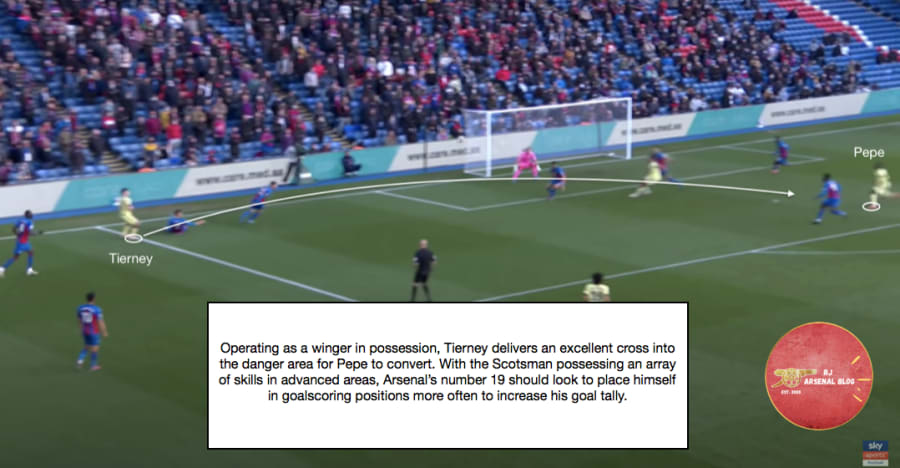
What Pepe should also focus on is his positioning in and around the 18-yard box. Whether it’s tactical or not, Arsenal’s record signing predominantly hovers around the edge of the penalty area when attacks are stemming through the left-hand side, instead of placing himself into regular goalscoring portions and utilizing his strong finishing capabilities to his advantage.
His first goal against Crystal Palace at Selhurst Park is a great example to illustrate how Arsenal capitalised on the excellent service provided by Tierney from the left flank – something the north Londoners need to do more often and in particular Pepe, who will increase his goal tally by making this slight adjustment to his game.
With Arteta potentially giving Saka an extended break following his late run in the Euro’s with the England national team, there is the likelihood that the 19-year-old may miss the start of the season, which should give Pepe a great opportunity to start the new campaign with a bang.
Hope you enjoyed the read! Please comment below as I’m intrigued to know your thoughts.