Perhaps it was a little much two weeks ago to say that Arteta should go if he couldn’t lead Arsenal to progress past Villarreal and into the Europa League final. After all, it’s a knockout competition. Weird things happen that can affect the outcome of these one-off ties; referees might give ludicrous dead ball situations to the opposition, an unlikely player on the other team might pull a spectacular goal out of thin air, or maybe an unfortunate ricochet could cost more than it should.
But at the very least, a respectable performance was required. Arsenal were up against Villarreal, who currently sit 6th in La Liga. Surely a club that had been on the cusp of leaving UEFA competitions to play in the Super League could muster a pair of dominant performances as an upper midtable side from Spain.
If that wasn’t enough motivation to inspire Arsenal to give a good account of themselves, there was also the fact that we were facing off against a side managed by Unai Emery. The man who had inspired more jokes at his expense than pride-inducing moments during his time in north London was ready and waiting to have his revenge. Arteta didn’t just need to avoid embarrassing the club — he needed to show the world that he was indeed better than the man he had been hired to replace.
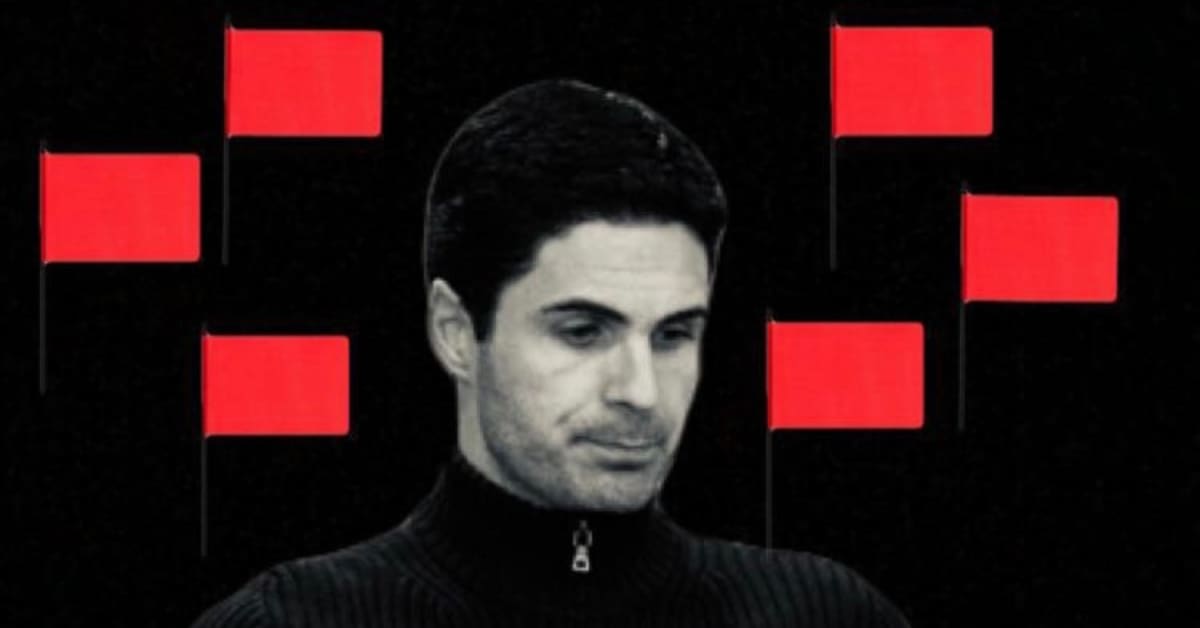
And yet, instead of delivering straightforward performances to earn Arsenal a place in the final, instead of even just delivering commendable showings regardless of the outcome of the tie, Mikel Arteta decided to roll out the hits. Almost every one of the red flags fans have expressed concern over for the sixteen months were on display over the course of the tie. The result is a humiliating defeat at the hands of man players and fans both at one time mocked, and the near certainty that Arsenal will not feature in European competition next season.
Constant tinkering and overcoaching
The first of Arteta’s fatal flaws presented itself from the very outset of the semifinal. With Alexandre Lacazette having suffered a hamstring issue and Pierre-Emerick Aubameyang still recovering from malaria, Arteta was left with limited options at center-forward for the first leg. Eddie Nketiah had been given an audition to start in their stead against Everton, but had proven unconvincing. Trusting Folarin Balogun with his first start for the senior squad in a European semifinal would have been unfair. The only remaining option appeared to be Gabriel Martinelli, who had spent much of the season training with the strikers.
However, Arteta settled on a different idea as his solution to the team’s striker problem. In a blatant emulation of Manchester City’s success from playing without a No. 9, Emile Smith Rowe was selected to lead the line. Behind him were Bukayo Saka, Martin Odegaard, and Nicolas Pepe.
At first, fans believed Pepe had been deployed as the center-forward. While some were disappointed not to see Martinelli there, Pepe is among the best finishers at the club and also has pace, more strength than he gets credit for, and a surprising knack for winning aerial duels. His deployment in the position made sense on some level with the usual starters out of commission. This quick rush to treat Pepe as the striker on the night is a fair indicator of how unbelievable it is that Smith Rowe was actually the one spearheading Arsenal’s attack.
The plan didn’t work. According to FBref, Arsenal produced an xG of 1.3 and only mustered one shot on target compared to six by Villarreal. Despite being in a losing position from the fifth minute of the match, Arsenal took only nine shots. They returned to London down 2-1 on aggregate. The one goal was a penalty kick slotted home by Pepe.
In the second leg, Arteta originally planned to start Granit Xhaka at left-back. However, the Swiss talisman was a late addition to the injury list, withdrawing from the starting lineup during pre-match warm-ups. In his place, Kieran Tierney started and played 80 minutes. It begs the question: if Tierney was essentially fit to play almost the entire match, why was Xhaka not set to start in midfield alongside Thomas Partey instead?
If Xhaka had been fit, Arsenal’s midfield would have been Partey, with Smith Rowe and Odegaard playing ahead of him as free eights. While that looks good on paper, Partey did not fare well left alone in midfield to contend with double marking. Odegaard, effectively played out of position, did not look comfortable either, and often killed attacks by passing backward on Thursday night. Partey and Xhaka as a midfield combination has proven to bring some stability to Arsenal’s play, but Arteta was ready to forego it and try something brand-new for the biggest game of his tenure as manager.
It is painfully ironic that when faced up against Emery, the man who drew the ire of the Arsenal faithful for never sticking to a consistent style of play, Arteta would lose the draw by essentially making the same mistake. It is an error that Arteta has made time and time again this season. When there are obvious areas of the opposition to exploit, the manager has overthought matters and scuppered the opportunity.
The same occurred here. In the first leg, Juan Foyth presented as the weakest link at right-back for Villarreal, and Pepe was matched up against him. But Pepe was not given anything close to the volume he should have received to take advantage of the mismatch.
In the second leg, Foyth was out injured. Etienne Capoue, viewed by many local pundits as one of Villarreal’s best players in the first leg, was suspended after seeing red in that match. Villarreal’s keeper Geronimo Rulli looked less than secure, repeatedly doing what he could to put the ball in his own net. After half an hour, Samuel Chukwueze had to be stretchered off the pitch. Villarreal were there for the taking on Thursday.
But Pepe again was not treated like “Thursday Night Arjen Robben”, given the ball as often as possible, and instructed to beat his man or cut in and shoot. No one was positioned next to Partey in order to dominate a midfield that Villarreal had vacated in order to block up the flanks. Instead of keeping it simple and trusting the talented players at his disposal to express themselves, Arteta overcomplicated the game plan, insisting on creating chances through no other method than the strictly rehearsed routine Arsenal stuck to.
As has happened so many times this season, the team looked flat. They lacked urgency when all they needed was a single goal to reach the final. But we’ve seen this enough to warrant thinking that this isn’t just fatigue setting in or an off night for everyone. The players out there looked confused. That’s likely because for the umpteenth time this season, their manager sent them out onto the pitch to follow a set of tactics they were barely familiar with and had not had enough time to master on the training ground.
Persistent struggles with substitutions
One of the biggest criticisms of Arteta’s management has been his trouble with making substitutions. Countless times this season, Arteta has waited far too long to make a much-needed change during a match. On other occasions, Arteta has made substitutions that didn’t seem to make sense. Both mistakes were made throughout the semifinal tie.
Dani Ceballos spent much of the first half of the away leg as Arsenal’s biggest liability. When he went forward with attacks, he left acres of space behind him. Foyth was able to drive into the gap left by Ceballos to great effect. To compensate, the Spaniard on loan from Real Madrid committed multiple silly fouls and eventually picked up a yellow card just before halftime.
If you were on social media during that match, you would have seen countless people singling out Ceballos as the first man who should be taken off. Many demanded that he not step back on the field for the second half. It was plain for all to see that he was a loose cannon, and that it was only a matter of time before he got himself sent off.
However, Arteta didn’t act to prevent that catastrophe. After the match, he would indicate that he had spoken with Ceballos and instructed him to stay out of trouble. But those instructions weren’t heeded. In the 57th minute of the match, Ceballos made another challenge and saw his second yellow.
One of Arteta’s darker hallmarks has been his seeming refusal to make changes before the last ten to fifteen minutes of a match. In the case of Ceballos, Arteta preferred roll the dice on a player’s recklessness than make a public admission that he had been wrong about how to approach an opponent. He consciously decided to risk going a man down in addition to being two goals down. Even now, it is a baffling decision.
In addition to that, Arteta waited until the 85th minute of the very same match to put on his best goalscorer. Despite having needed a goal for eighty minutes by that point, the Arsenal manager figured that five minutes would be enough time for Aubameyang to find the back of the net. Obviously, it wasn’t.
Arteta’s substitutions in the second leg wouldn’t prove much better. After 80 minutes, while still chasing a goal, Arteta took off the club’s most prolific striker of the last couple years. Aubameyang had taken three shots and hit the post twice, but the manager saw fit to replace him anyway.
And while some may feel Aubameyang’s continued recovery from malaria may have been a factor, waiting 80 minutes to sub him off for that reason makes little sense. Aubameyang had almost completed the match, and with the remaining Premier League fixtures essentially being dead rubbers, he could have been rested ahead of a potential final. In any case, the Gabonese forward did not look happy to come off, and it is difficult to blame him for that during the most important match of the season.
Lacazette took Aubameyang’s place on the field, and as has become Arteta’s trademark, was given very little time to make a big impact. He ended the match with one shot-creating action and no shots to his name.
In addition to Lacazette’s introduction, Willian came on the pitch as well. Willian, who now has no goals from 36 appearances for the club, was brought on to save Arsenal at the most pivotal moment of the season. When it was all on the line, Mikel Arteta once again turned to a man who has repeatedly failed him when called upon. And he gave him only ten minutes to do what he had not done before.
It seems as though Arteta is more concerned with looking clever while winning matches instead of simply winning matches. Instead of simply keeping the most dangerous Arsenal player on the pitch, he took him off for a striker just returning from a hamstring injury with the hope he could serve as a fulcrum for the young attackers on the pitch. When he could have played it safe and replaced the defensive liability who was committing fouls all over the pitch, he believed a brief halftime chat would solve the problem. And in a moment of truth, he threw on the biggest transfer bust of his young career, desperate to show that he was right to make that decision.
Overusing key players
Granit Xhaka has been one of the main lieutenant’s of Arteta’s Arsenal. At the time of writing, the former club captain has made 43 appearances this season. After Tierney suffered a knee injury and Cedric Soares produced an utterly diabolical last few minutes to prevent Arsenal from winning their home leg against Slavia Prague, Xhaka was called upon to play at left-back.
To his credit, Xhaka has deputized solidly enough at the position. While wingers such as Richarlison and Chukwueze have gotten the better of him there, he has not been a disaster while serving in the role. With Cedric clearly having fallen out of favor, Arteta should have done anything possible to preserve Xhaka’s fitness until Tierney could return.
But, as Arteta has done several times this season, the manager deployed an important player in unimportant games too many times. Xhaka was used as a left-back for six consecutive full matches. Even in Arsenal’s Premier League fixture between the two legs of the semifinal, in which they faced a mediocre Newcastle side, Arteta saw fit to make one of his team’s most critical players complete a full 90 minutes in a physically demanding role.
Xhaka has been stunningly durable this season. But even he has a limit. That limit showed itself in the warm-up ahead of Thursday’s match when Xhaka pulled out of the starting XI due to muscle tightness. Xhaka could probably have avoided this injury concern if he had been rested for the home leg against Villarreal. But Arteta chose the gamble of playing him for a sixth consecutive time over trusting Cedric to deal with a Newcastle team that produced an xG of 0.2.
Another crucial player Arteta needlessly risked against Newcastle was David Luiz. The Brazilian center-back was just returning from a knee injury, and the manager opted to play him for a full match at St. James’ Park to establish some form. Just after halftime, Luiz suffered a hamstring injury that ended his day. As a result, Luiz was unable to feature on Thursday.
While it may be harsh to blame Arteta for Luiz’s injury, the fact remains that saving him for Villarreal would have allowed him to play at least a portion of the match and perhaps help get a result. But Arteta is surely to blame for overplaying Xhaka. Because of the manager’s decisions, Arsenal were without their two best distributors from the back for the most critical match of the season.
Style of play that does not create enough chances
Entire treatises on how little chance creation Arteta’s style of play entails will likely be written in the offseason, so an in-depth analysis of that topic will not be explored here. However, it is fairly common knowledge at this point that Artetaball has regularly featured low-xG showings with few big chances being created and not much on offer in terms of shots either. It is well-documented that Arteta’s Arsenal produce far fewer big chances and shots than Wenger’s or Emery’s did.
So it is no surprise that when a single goal separated Arsenal from a place in the Europa League final, they took 14 shots and only put one on target. Most of Arsenal’s attempts were half-chances or headers from crosses. Aside from Aubameyang’s willingness to cut inside on his strong foot and shoot, the Gunners once again seemed limited to flinging crosses in from the wings or cutbacks from the byline into a crowded penalty area.
In the first leg, Arsenal produced an xG of 1.3. In the second, they only mustered a single expected goal. The slow, ponderous, strictly choreographed passing patterns around the penalty area that Arteta has instilled in the side simply do not work. It is no coincidence that the 0-0 draw against Villarreal marked the first time in the club’s history that Arsenal have failed to score in 10 home matches during a single season.
* * *
The Arsenal faithful have spent the season casting a watchful eye on Arteta’s project. Some have preached a need to trust the process. But the red flags have been there, lurking in the team’s disappointing performances over the last several months. On Thursday night, almost all of them featured in what can only be described as a heartbreakingly toothless performance. Arteta has promised that soon the Arsenal rebuild will go “bang”. But when the chips were down, he failed to overcome his own worst flaws, and a once great club has exited European competition with a whimper.
If you enjoyed this article, follow me on Twitter @dopegooner.