Arriving as a 22-year-old from Scottish Football, where he spent the first 4 years of his top-flight career playing for his boyhood club Celtic, Kieran Tierney became an overnight cult figure in the Arsenal fandom.
It wasn’t the Tesco bags or the short sleeves in the winter that really appealed to the fan base. It was the level of consistency, aggression, and leadership on and off the field that really made Tierney a standout player.
2020-21 has been like learning to ride the bicycle for Mikel Arteta while trying to tie his shoe and keeping his pants from falling down. The manager has had to find a way to stop the team from leaking goals, improve chance creation and to fit all that into a system that doesn’t suit the ragtag group of players that makes up the squad. Did I mention the off-field issues?
In the chaos Tierney has been utilized mainly as an outlet on the left-wing, holding the width while the left-sided CM (Xhaka in most cases) plugs the gap at LB in possession to stop teams from transitioning through Arsenal, in case of a turnover. The thinking behind having Tierney hold the width early in the lifecycle of the 3-4-3 was to allow Aubameyang to move inward to attack the box, in addition to trying to get 5 players in the 5 attacking zones. Tierney’s physical ability and fitness facilitated the role as he could recover should Arsenal turnover possession.
As the season went on and with the addition of ESR, the left side became really potent weapon for Arsenal as they looked to channel most of their possession through that wing. That combination is expected to continue going into the 2021-22 season.
This created an interesting profile for Tierney, most clearly seen from the zones where he received the most progressive passes in the second phase.
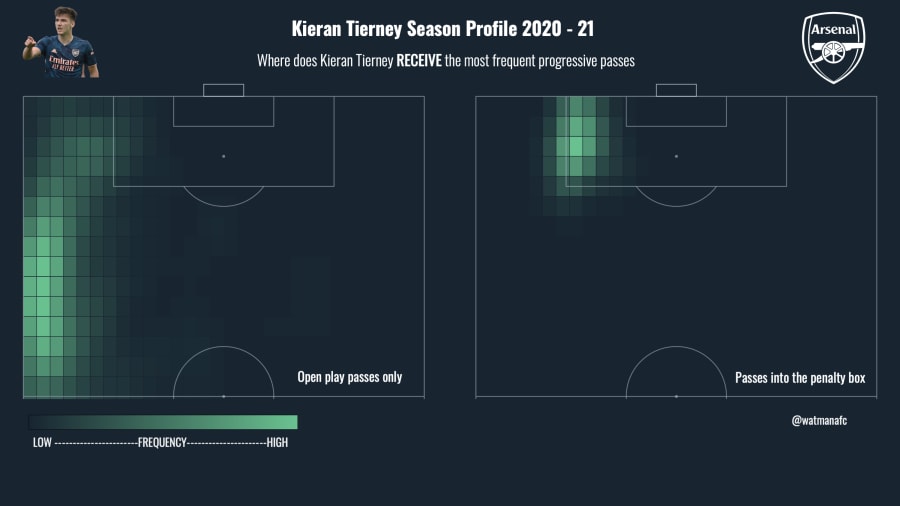
As any modern wingback/fullback his receptions in the penalty area were clustered around the edge of the box, facilitating cutbacks into central zones, a tactic that Arsenal have employed for chance creation throughout the season partly due to the lack of central creators.
Further evidence of this is in his crossing, the picture becomes even more interesting and puts into spotlight the style of attacking play Arsenal have tried to deploy.
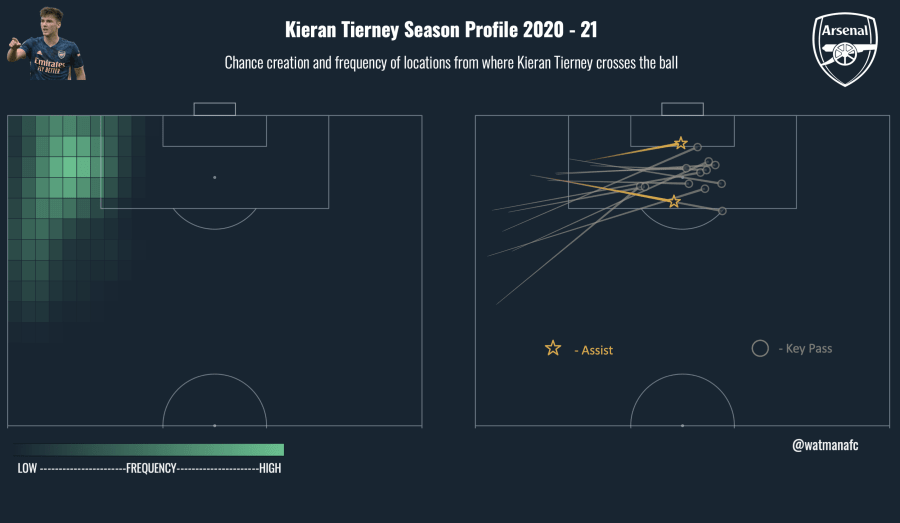
Most crosses from Tierney started around the edge of the box, with a healthy number of them coming from zones going right up to the byline, where he would try to cut the ball back around to the penalty spot for an oncoming attacker.
Whilst this was in theory an excellent tactic, it didn’t really work that well for Arsenal, as they found it difficult to consistently get players in behind the opposition defence. Part of this was due to a real lack of movement in the final third. Tierney’s key passes coming from deeper areas and near the edge of the penalty box further drives the point home.
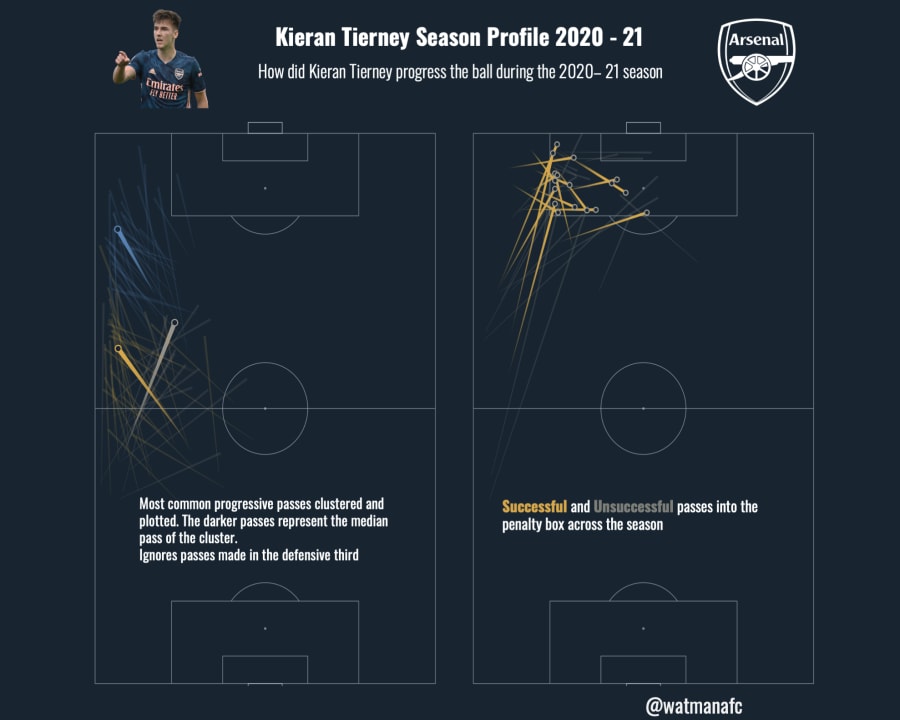
While most of his time was spent hugging the line, he has shown that there is so much more to his game than just that. A progressive pass is defined as any pass that moves the ball closer to the goal by 25%, so by filtering the passes made in the final third to take out clearances and long balls, we see a pattern.
Tierney was equally proficient coming inside to link play as he was staying wide and maintaining width. His most common progressive passes are clustered around the middle third, playing runners out wide & advancing the team from midfield.
Tactically there is a case to be made of inverting him into midfield, like Zinchenko at City, to create more seamless patterns down the left side during build-up. The conventional wisdom is that Arsenal need a right back who is proficient at inverting and holding width, but we already have someone like that on the left.
This could result in a more balanced playstyle as Arsenal can create natural rotations with wingers, wingbacks, and centre mids on both wings, should the manager choose to continue progressing team development with the same principles we have seen this season.
Notice his passes into the penalty area mostly originate from deeper areas – this shows that he can play in the half-space and look for runners while a winger holds the width. Arsenal need to find a way of getting him closer to the box in those areas next season, potentially creating more patterns of play to facilitate rotations in the final third. This has a knock-on effect of having a central midfielder go beyond the midfield line and hold a position in the front line.
Tierney allows the team to have more tactical flexibility in attack and build-up, but doesn’t lack any bite or energy in the defensive department.
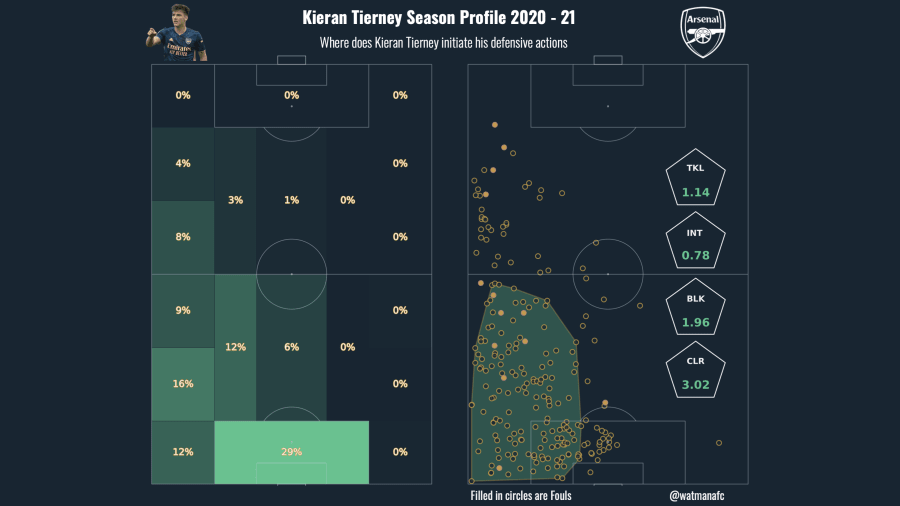
His defensive actions occurred mostly in the penalty box – this isn’t surprising because Arsenal defend in a back 5 when deep in their box and he is usually really high up the pitch during transitions. However, Tierney is mostly very clean when engaging players as seen by the number of fouls he has given away.
What is more, in line with the way he has played this season are his defensive actions in the opposition half. While Arsenal haven’t been the most aggressively pressing side, they have looked to deploy a counter-press on occasion when losing possession high up the pitch.
Tierney had a high-quality season in a very average team this season. He should carry this form into the Euros with Scotland and into next season with Arsenal. He would definitely be named in the leadership group at the club, only cementing his place further as one of the most important players in the squad.
Arsenal will need more players of his ilk and mentality if they are to have any chance of getting into the Top 4.